 Xinchuan Server | Enterprise Server Hardware Supplier
One 2U Chassis, Four Workloads, Zero Compromise
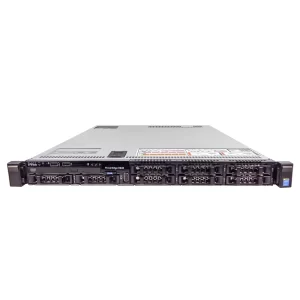
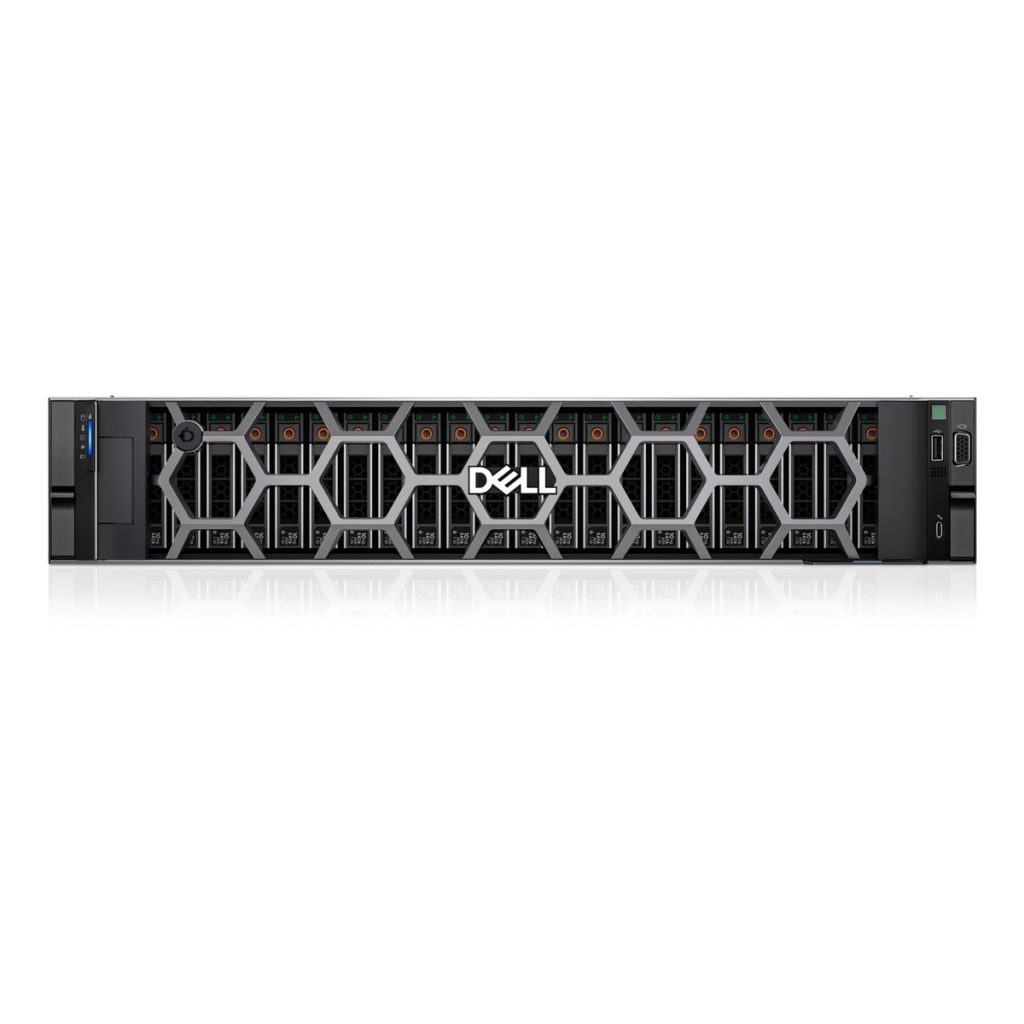
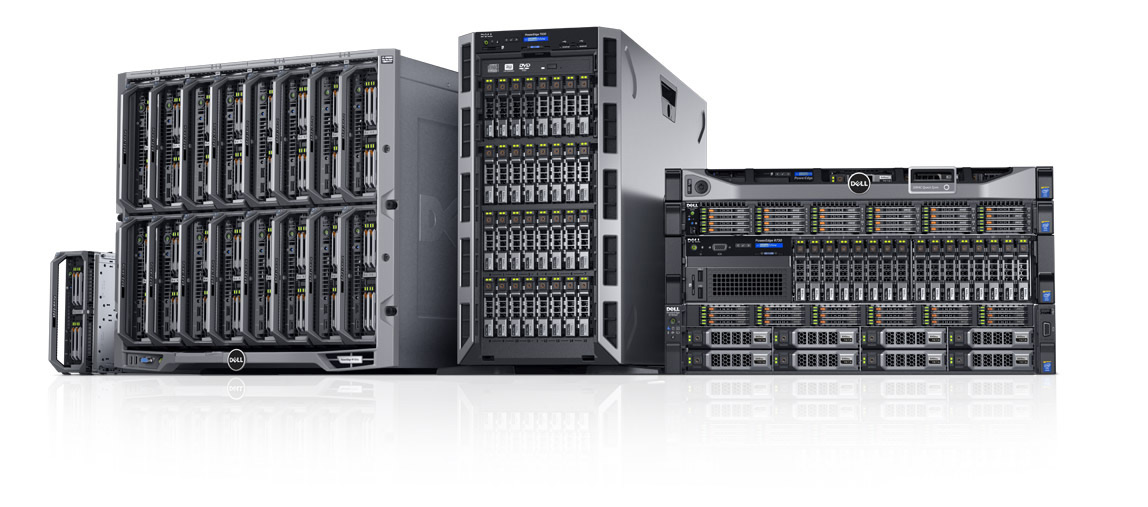
The Dell PowerEdge R760 is the mainstream 2U dual-socket rack server that data center teams standardize on when they need one platform to run everything: virtualized estates, SQL and analytics, VDI pools, and AI/ML inference pilots. It pairs up to two 5th Generation Intel Xeon Scalable processors (64 cores each) with 32 DDR5 slots, flexible drive-bay layouts from 12 x 3.5-inch to 24 x NVMe U.2, and up to 8 PCIe slots – so the same chassis scales from a budget virtualization node to a GPU-equipped inference box.
Core Specifications
| Component | Specification |
|---|---|
| Form factor | 2U rack server |
| Processor | Up to 2 x 4th Gen Intel Xeon Scalable or Xeon Max (56 cores) / 2 x 5th Gen Intel Xeon Scalable (64 cores), optional Intel QuickAssist |
| Memory | 32 x DDR5 RDIMM slots, up to 8 TB, 4800 MT/s (4th Gen) or 5600 MT/s (5th Gen) |
| Drive bays | Front: 12 x 3.5″ SAS/SATA, 8/16/24 x 2.5″ SAS/SATA/NVMe, 16 x EDSFF E3.S Gen5; Rear: 2/4 x 2.5″, 4 x E3.S |
| RAID | PERC H965i / H755 / H755N / H355, PERC H965e external, BOSS-N1 (2 x M.2 NVMe), HBA355i/e, HBA465i, S160 software RAID |
| PCIe | Up to 8 x PCIe slots (Gen5/Gen4 mix, SNAPI option) |
| GPU | Up to 2 x 350 W double-wide + 6 x 75 W single-wide |
| Management | iDRAC9, iDRAC Direct, Redfish RESTful API, Quick Sync 2 |
| Dimensions | 86.8 x 482 x 772.13 mm (3.41 x 18.97 x 30.39 in, with bezel) |
Configuration Calculator: Match the Chassis to the Workload
Instead of one “standard” build, the R760 is ordered by workload. Use this matrix as your starting point:
| Workload | Suggested build | Why it works |
|---|---|---|
| Mixed virtualization | 2 x Xeon (32-56 cores), 512 GB-1 TB DDR5, 8-16 x 2.5″ SAS/SATA + 2 x NVMe boot | Core density for VMs, BOSS-N1 boot, PERC H755 |
| AI/ML inference | 2 x 5th Gen Xeon, 1-2 x double-wide GPU (350 W), 16 x E3.S Gen5 NVMe | GPU headroom + high-bandwidth Gen5 flash |
| Database & analytics | 2 x Xeon Max / high-core SKU, 2-4 TB DDR5, 24 x NVMe U.2 | Memory bandwidth and NVMe latency |
| VDI | 2 x Xeon, 1-2 TB DDR5, 24 x 2.5″ SAS/SATA SSD, dual 10/25GbE OCP NIC | IOPS density + network capacity |
Storage & RAID Flexibility
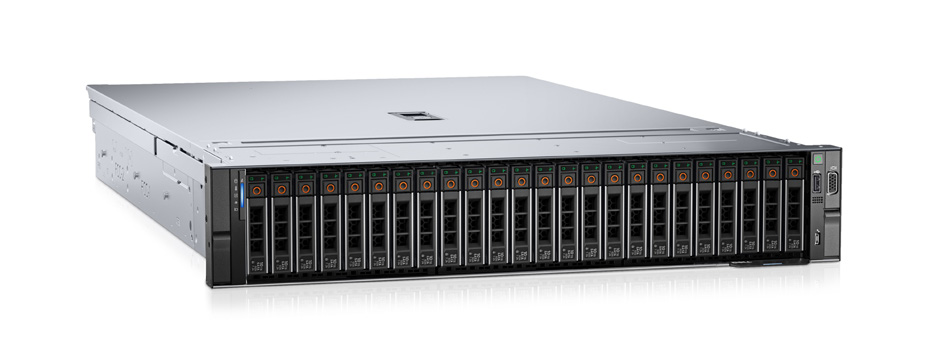
The R760 covers the full storage spectrum. Front bays scale from 12 x 3.5-inch SAS/SATA (up to 240 TB) to 24 x 2.5-inch SAS/SATA/NVMe (up to 368.64 TB) and 16 x EDSFF E3.S Gen5 drives; rear bays add 2-4 more 2.5-inch drives or 4 x E3.S. NVMe options include up to 24 x U.2 Gen4.
RAID choices range from PERC H965i (tri-mode, hardware RAID with cache) and PERC H755 to the BOSS-N1 boot subsystem with 2 x M.2 NVMe in hardware RAID, plus HBA355i/e non-RAID HBAs and S160 software RAID. PERC controllers support RAID 0/1/5/6/10/50/60 with battery-backed or NV cache – see the specific card for cache sizing.
Network & PCIe Expansion
Networking is modular: an optional 2 x 1GbE LOM card, an optional OCP 3.0 card (1/10/25/100GbE), or a Management Interface Card for a Dell DPU – the system accepts LOM, OCP, or both. Eight PCIe slots mix Gen5 and Gen4 with full-height, low-profile and SNAPI options, so HCA, dual-port NIC and storage controller cards coexist without reconfiguring the chassis.
Front Bay Configurations
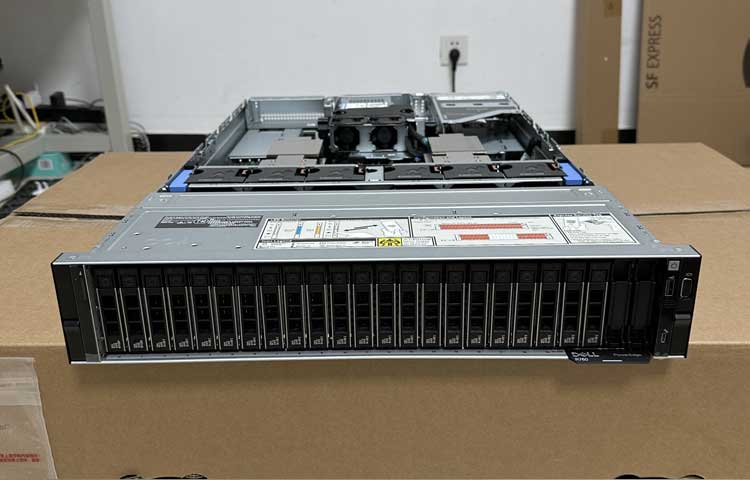
No other decision on this platform shapes the build as much as the front cage, because the R760 spans everything from a twelve-bay 3.5-inch capacity chassis to a twenty-four-bay all-NVMe node, and the backplane is fixed at order. The same 2U shell, four different storage personalities.
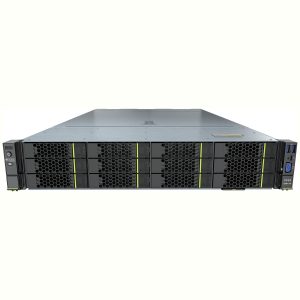
The 3.5-inch option is the capacity play: twelve bays of SAS or SATA reaching 240 TB, which is the right answer for backup targets, object storage and archive tiers where cost per terabyte beats latency. The 2.5-inch options — eight, sixteen or twenty-four bays — cover the mixed-media middle ground and the all-flash database node respectively, with 24 bays reaching 368.64 TB. And the sixteen-bay E3.S Gen5 option is the density play, carrying more Gen5 lanes per drive than a U.2 backplane can.
The rear cage is worth specifying at the same time. Two or four additional 2.5-inch drives, or four E3.S, give you a physically separate tier for boot mirrors, logs or a fast recovery copy without consuming a front bay that could hold production data.
| Configuration | Media | Maximum capacity | Where it fits |
|---|---|---|---|
| 12 × 3.5-inch | SAS or SATA | 240 TB | Backup, archive and object tiers |
| 8 × 2.5-inch | SAS, SATA or NVMe | Media dependent | Entry builds, low drive count |
| 16 × 2.5-inch | SAS, SATA or NVMe | Media dependent | Balanced virtualization nodes |
| 24 × 2.5-inch | SAS, SATA or NVMe | 368.64 TB | All-flash database and VDI |
| 16 × E3.S Gen5 | E3.S NVMe | Media dependent | Gen5 flash density |
| Rear 2/4 × 2.5-inch | SAS, SATA or NVMe | Additional tier | Boot mirror, logs, recovery copy |
| Rear 4 × E3.S | E3.S NVMe | Additional tier | Fast scratch or cache tier |
GPU and Accelerator Configurations
The R760 supports two 350 W double-width accelerators plus six 75 W single-width cards, which is a genuinely useful envelope for inference rather than a checkbox feature. It is not a GPU training chassis — for eight-way GenAI training you need the XE9680 — but for a node that serves models rather than trains them, two 350 W cards cover a large share of production inference workloads.
The constraint that catches people is the interaction between GPU count, drive count and PSU class. A build with two 350 W cards, twenty-four NVMe drives and two 350 W processors needs the higher PSU ratings and the high-performance fan configuration, and on air cooling the drive count may have to come down to stay inside the thermal envelope. Plan the GPU, storage and cooling decisions together rather than in sequence.
| Configuration | Power envelope | Typical use |
|---|---|---|
| 2 × 350 W double-width | Up to 700 W of accelerator load | Model inference, video analytics, VDI graphics |
| 1 × 350 W double-width | Up to 350 W | Single-model serving with headroom for a second card |
| 6 × 75 W single-width | Up to 450 W | Dense low-power inference, transcode farms |
| Mixed DW + SW | Slot and power dependent | Inference plus transcode in one node |
| No accelerator | — | Virtualization, database, general compute |
Memory: 32 Slots, Two Population Schemes
Thirty-two DDR5 slots across two sockets is sixteen per socket, eight channels at two DIMMs per channel. As on every current dual-socket platform, the population scheme decides whether you get peak bandwidth or peak capacity.
One DIMM per channel populates sixteen slots at the full 5,600 MT/s on 5th Gen Xeon, topping out at 4 TB with 256 GB RDIMMs. Two DIMMs per channel fills all thirty-two slots, reaches 8 TB, and runs at 4,800 MT/s. On a 4th Gen Xeon build the corresponding figures are 4,800 and 4,400 MT/s.
For virtualization the capacity scheme wins almost every time, because clusters run out of memory before they run out of CPU. For analytics and in-memory databases, measure whether the workload is actually bandwidth-bound before trading capacity for speed — on most column-store engines the working set matters more than the transfer rate.
| Population | DIMMs fitted | DIMM size | Total capacity | Speed |
|---|---|---|---|---|
| 1 DPC | 16 | 64 GB | 1 TB | 5,600 MT/s |
| 1 DPC | 16 | 128 GB | 2 TB | 5,600 MT/s |
| 1 DPC | 16 | 256 GB | 4 TB | 5,600 MT/s |
| 2 DPC | 32 | 64 GB | 2 TB | 4,800 MT/s |
| 2 DPC | 32 | 128 GB | 4 TB | 4,800 MT/s |
| 2 DPC | 32 | 256 GB | 8 TB | 4,800 MT/s |
Buying a Used or Refurbished R760
The R760 is the most widely deployed 2U dual-socket platform of its generation, which makes it the most liquid machine on the second-hand market and the easiest to buy well. Supply is dominated by three-year virtualization clusters, generally with sensible memory populations and moderate drive counts.
Verify the front cage first, since the twelve-bay 3.5-inch and twenty-four-bay 2.5-inch chassis are entirely different machines in use. Verify the processor generation, because 4th and 5th Gen Xeon share the model name but differ in core count and memory speed. Verify the memory population rather than the capacity figure. Confirm the GPU riser configuration if you intend to fit accelerators, because a chassis built without GPU power cabling needs parts that are not always available separately. And confirm the iDRAC9 licence tier, since System Lockdown and full telemetry depend on Enterprise entitlement.
| Check | Why it matters |
|---|---|
| Front cage type | 3.5-inch capacity and 2.5-inch performance are different chassis |
| Processor generation | 4th and 5th Gen differ in cores and memory speed |
| Exact DIMM map | Same capacity can mean 5,600 or 4,800 MT/s |
| GPU riser and cabling | Accelerator power cabling is not always sold separately |
| PSU pair | Matched supplies, correct input class for 3,200 W builds |
| iDRAC9 licence | Enterprise tier drives System Lockdown and telemetry |
Security & Management
Cyber-resilient by design. Silicon root of trust anchors end-to-end boot resilience; Secure Boot, cryptographically signed firmware, Secured Component Verification (hardware integrity check), Secure Erase, System Lockdown (iDRAC9 Enterprise) and Data at Rest Encryption via SEDs protect the server from factory to decommission. TPM 2.0 ships FIPS/CC-TCG certified, with a China NationZ variant available.
Autonomous operations. iDRAC9 delivers out-of-band control with a dedicated management port, HTML5 virtual console, virtual media, hardware telemetry, Redfish RESTful API and the iDRAC Service Module. Fleet-wide, OpenManage Enterprise automates updates, power management and service workflows with integrations for VMware vCenter, Microsoft System Center, Ansible and Terraform.
Power, Cooling & Physical
- PSU: Hot-swap redundant supplies from 700 W Titanium to 3200 W Titanium (277 VAC/336 HVDC), including Platinum 800 W/1400 W/2400 W and a -48 VDC 1100 W option for telco environments.
- Cooling: Air-cooled Smart Flow chassis for up to 16 x 2.5-inch drives and 2 x 350 W processors; optional Direct Liquid Cooling (rack solution with manifolds and CDU) for the highest-core builds; up to 6 hot-plug fans (STD / HPR Silver / HPR Gold).
- Dimensions: 86.8 x 482 x 772.13 mm (with bezel). Weight varies by configuration – request the exact figure with your build.
OS & Hypervisor Support
Certified for Canonical Ubuntu Server LTS, Microsoft Windows Server with Hyper-V, Red Hat Enterprise Linux, SUSE Linux Enterprise Server and VMware ESXi – the full mainstream stack, verified by Dell’s OS support matrix.
Building a mixed workload fleet? We supply the R760 configured to your target specification, with competitive pricing, 3-year warranty on new units and a 12-month warranty on refurbished units, global shipping and free configuration consultation – including drive-bay selection, GPU riser planning and PSU sizing against your actual power rate. Contact us for a quote.
Frequently Asked Questions
Which processors does the R760 support?
Two 4th Gen Intel Xeon Scalable or Xeon Max processors at up to 56 cores, or two 5th Gen Xeon Scalable at up to 64 cores, with optional Intel QuickAssist. The two generations share the platform but differ in core count and memory speed.
What is the maximum memory, and at what speed?
8 TB with all 32 slots populated using 256 GB RDIMMs at 4,800 MT/s on 5th Gen Xeon. A 16-DIMM one-per-channel build reaches 4 TB at the full 5,600 MT/s. On 4th Gen Xeon the equivalent speeds are 4,400 and 4,800 MT/s.
How many NVMe drives can it take?
Up to twenty-four U.2 Gen4 NVMe drives, or sixteen EDSFF E3.S Gen5 drives, plus rear bays for a further two or four 2.5-inch drives or four E3.S.
Can it take GPUs?
Two 350 W double-width accelerators plus six 75 W single-width cards. That covers production inference, video analytics and VDI graphics. For eight-way GenAI training, the XE9680 is the right chassis.
Which RAID controllers are available?
PERC H965i, H755, H755N and H355 internally, PERC H965e for external enclosures, plus HBA355i/e and HBA465i non-RAID HBAs, BOSS-N1 for M.2 boot and S160 software RAID.
Is liquid cooling available?
Yes. Direct Liquid Cooling is an option for the highest-core builds and is delivered as a rack-level solution with manifolds and CDU. Standard builds use the air-cooled Smart Flow chassis with up to six hot-plug fans.
How does the R760 compare with the R770?
The R770 is the Xeon 6 successor: DDR5 at 6,400 MT/s, E3.S density up to forty bays and a 2U DC-MHS chassis. The R760 remains the mainstream buy on 4th and 5th Gen Xeon, with a wider choice of drive-bay layouts and a lower entry price.
What is the remote management stack?
iDRAC9 with Redfish RESTful API, HTML5 virtual console, virtual media, hardware telemetry, iDRAC Direct and Quick Sync 2, with OpenManage Enterprise for fleet operations and integrations for vCenter, System Center, Ansible and Terraform.
Can the configuration be changed before shipping?
Yes. CPU, memory, drives, RAID card, power supply and rails can all be configured to your requirement. Send the target specification and we quote against it.
Are the servers tested before dispatch?
Every unit is powered on, firmware-checked and burn-in tested before dispatch. Test logs or photos can be shared on request.
Do you supply rails, bezel and cable management arm?
Rails and accessories are quoted separately or bundled. Tell us the rack depth and we confirm the right rail kit for the chassis.
Can you confirm the exact model, part number and condition before I order?
Yes. Before the order we send the exact model, part number, condition and full configuration list — CPU, memory, drives, RAID card, power supply — for your written confirmation.
How are warranty and lead time handled?
Warranty and lead time are quoted per order, because they depend on configuration and destination. Condition grade is stated per unit, on every quote line. Nothing is assumed on our side.