 Xinchuan Server | Enterprise Server Hardware Supplier
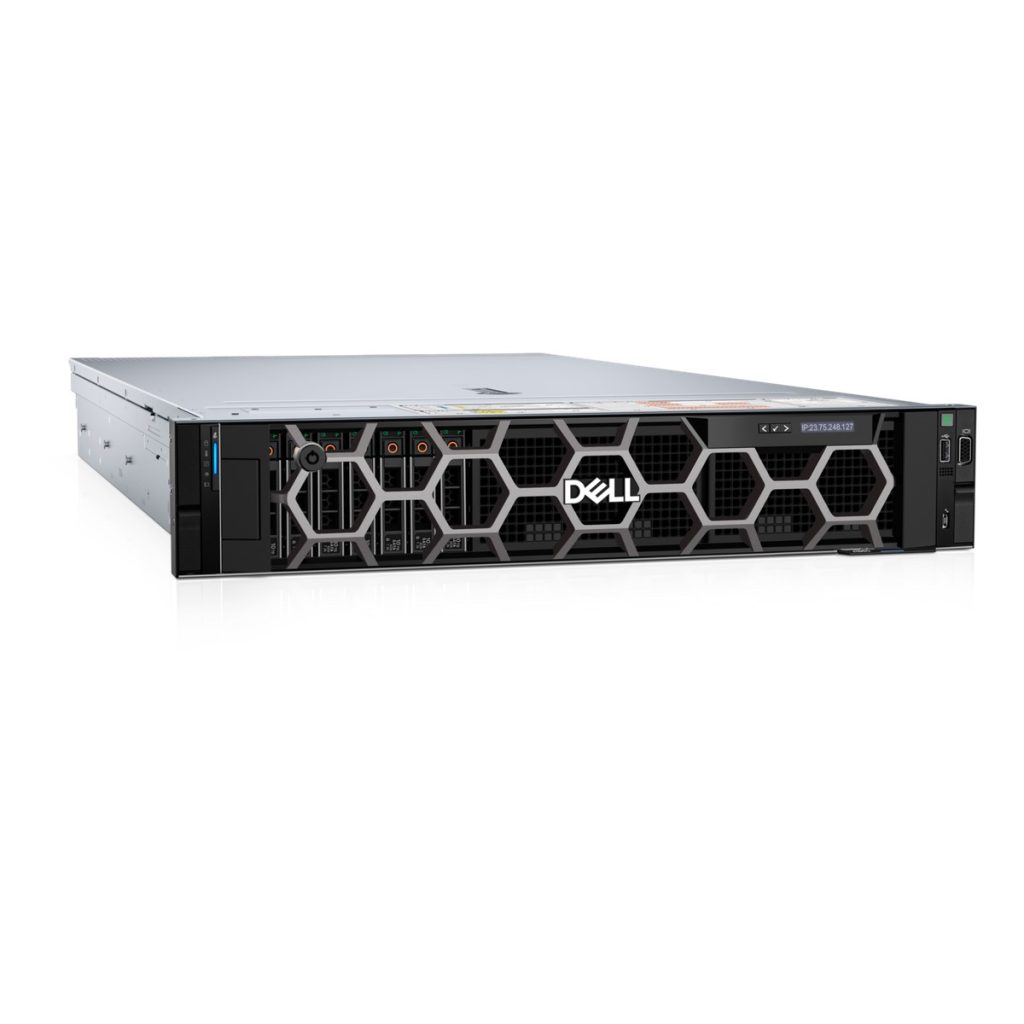
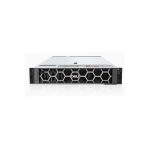
Four Sockets in 2U: Why the R860 Exists
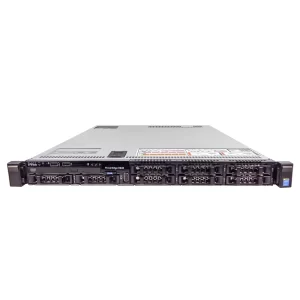
The PowerEdge R860 answers a specific question: what do you do when two sockets cannot hold the working set? SAP HANA scale-up, large in-memory analytics and consolidated 4-socket databases need more memory than any 2-socket node can carry – and the R860 delivers up to 16TB of DDR5 in a standard 2U chassis, replacing the older R840 with a Gen5-era platform.
Platform Overview
| Attribute | R860 |
|---|---|
| Form factor | 2U rack, 869.2 mm depth (no bezel) |
| Processors | Up to 4x 4th Gen Intel Xeon Scalable, up to 60 cores each, 350W TDP, 80 PCIe 5.0 lanes per CPU |
| Memory | 64 DDR5 RDIMM slots, up to 16TB; 4800 MT/s (1 DPC) / 4400 MT/s (2 DPC) |
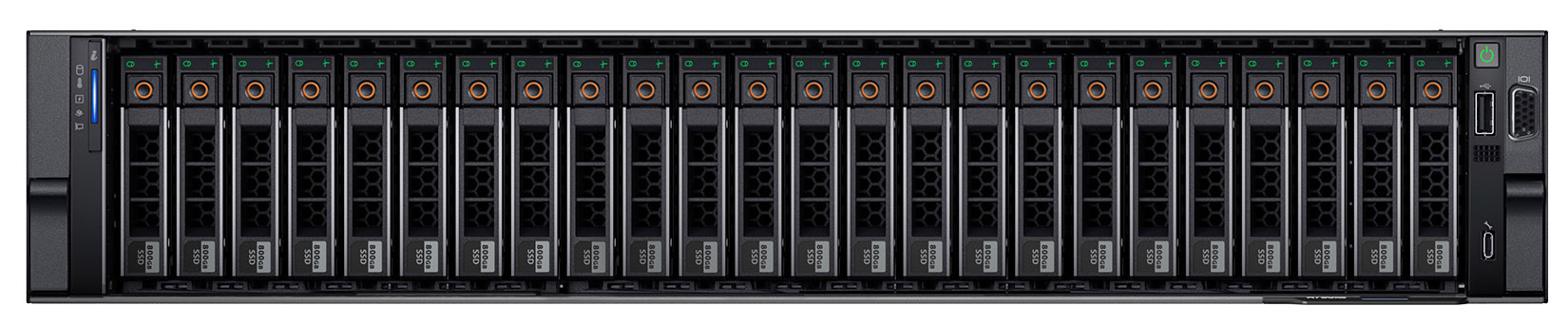
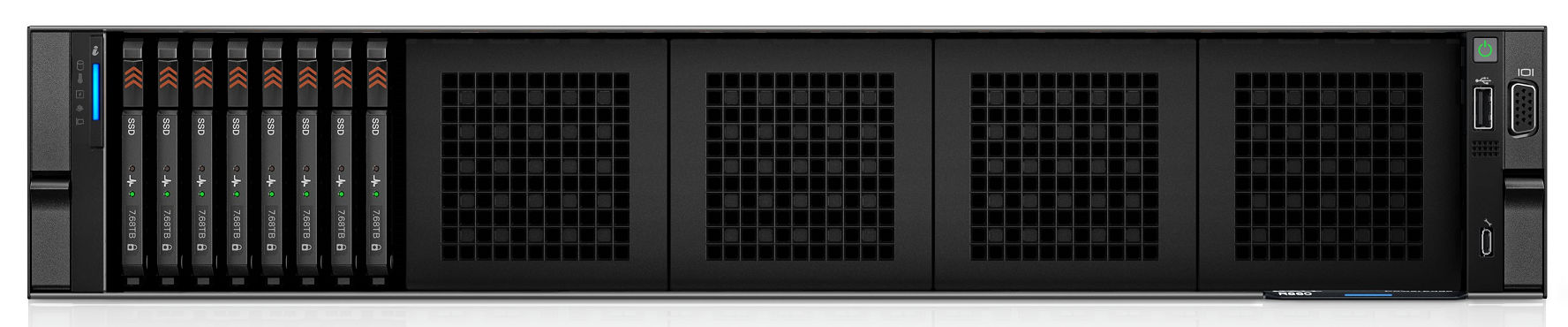
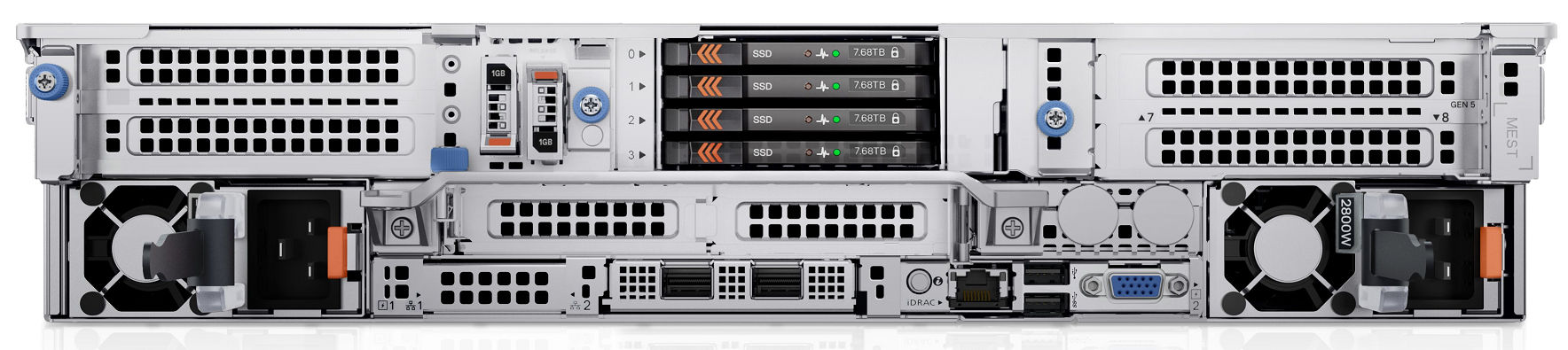
| Storage | Up to 24x 2.5-inch SAS/SATA/NVMe or 8x E3.S Gen5 (front) + 2x 2.5-inch or 4x E3.S Gen5 (rear) |
| PCIe | Up to 8x PCIe Gen5 x16 slots; OCP Mezzanine 3.0 |
| RAID | PERC 11/12 (H755, H965i/H965e), HBA465i/e, BOSS-N1, software RAID S160 |
| Management | iDRAC9, iDRAC Direct, Redfish API, Quick Sync 2 |
| Power | 2x redundant PSU: Titanium 1100W, Platinum 1400W, Titanium 1800W, Platinum 2400W (AC/HVDC) |
Config Calculator: SAP HANA Memory Sizing
- Working set: sum of hot data + column-store + delta + 20% headroom. A 4TB HANA database with 1:2 compression needs roughly 2.2-2.5TB of server memory.
- DIMM plan: 64 slots. 1 DPC runs 4800 MT/s but caps capacity; 2 DPC reaches 16TB at 4400 MT/s. For HANA, capacity beats peak speed – run 2 DPC with 256GB RDIMMs (8TB class) or 512GB (16TB class) if the budget allows.
- Verify NUMA: four sockets mean four NUMA domains; pin HANA instances and their memory pools per socket to avoid cross-socket traffic.
- Boot and log: BOSS-N1 (2x M.2 NVMe RAID1) for boot, E3.S Gen5 NVMe for HANA data/log/backup volumes.
R840 to R860 Migration
| R840 (previous gen) | R860 |
|---|---|
| 48 DDR4 DIMM + Optane PMem | 64 DDR5 RDIMM, up to 16TB, no PMem dependency |
| PCIe Gen3 slots | Up to 8x PCIe Gen5 x16 slots |
| PERC 9/10 (H740p/H840) | PERC 11/12 (H965i/H965e), HBA465 |
| 24G SAS/6G SATA, Gen3/4 NVMe | 24G SAS, Gen4 NVMe, plus E3.S Gen5 front/rear |
| 865.9 mm depth | 869.2 mm depth – rack depth check required |
The migration path is export-backup-restore: back up HANA at the storage layer, restore onto the R860’s NVMe, then re-point the scale-up licenses. Expect materially faster column scans on Gen5 NVMe and DDR5 bandwidth.
Procurement Traps on 4-Socket Servers
- License math: SAP HANA is licensed per GB of memory – a 16TB R860 costs far more in license than hardware. Size the DB, then size the box, not the reverse.
- Memory topology: verify 1 DPC vs 2 DPC speeds in the quote; vendors quoting 4800 MT/s on a full 16TB build are not reading the spec sheet.
- Rear bays: 24x 2.5-inch front config leaves rear room for 2x 2.5-inch or 4x E3.S – confirm the backplane SKU matches your boot/NVMe plan.
- PSU class: 4x 350W CPUs plus 24 drives can exceed 2kW; order 2400W Platinum pair, not 1100W.
- Rack depth: 869.2mm is long for standard 800mm cabinets – verify cable management arms and rail fit.
Workload Fit
- SAP HANA scale-up: the primary design point – see our SAP HANA deployment guide for R960/R860 sizing.
- Large in-memory analytics: 64 DDR5 slots beat any 2-socket node for column-store analytics.
- Consolidated databases: run multiple mission databases with resource isolation on one 4-socket host instead of several 2-socket boxes.
- VDI and desktop virtualization: high-core-count 4S nodes sustain dense RDSH pools.
Detailed Specs, Dimension by Dimension
Networking
- LOM board: 2x 1GbE with Broadcom BCM5720 (optional)
- OCP Mezzanine 3.0 slot supported by up to 16 PCIe lanes – 25GbE/100GbE mezz options
- PCIe Gen5 slots carry full-height NICs at 32 GT/s when network density demands
Front and Rear I/O
- Front: 1x USB 2.0, 1x iDRAC Direct (Micro-AB USB), 1x VGA
- Rear: 1x dedicated iDRAC Ethernet, 1x USB 3.0, 1x USB 2.0, 1x VGA (optional on liquid-cooled configs), optional serial via STD RIO board
- Internal: 1x USB 3.0; optional LCD bezel or security bezel
Riser and PCIe Architecture
- 80 PCIe 5.0 lanes per CPU at 32 GT/s; up to 8x Gen5 x16 slots system-wide
- Flexible riser layout across sockets 1-4; plan slot-to-NUMA affinity before ordering
RAID and Boot
- PERC 11: H355, H755; PERC 12: H965i, H965e (tri-mode)
- HBA 11/12: HBA355i/e, HBA465i/e
- BOSS-N1 for OS boot (2x M.2 NVMe, hardware RAID 1); software RAID S160 for SATA
Security
- TPM 2.0, UEFI Secure Boot, silicon root of trust, signed firmware and secure boot chain verified at every POST – Dell PowerEdge platform security baseline
Management
- iDRAC9: remote console, virtual media, telemetry streaming, lifecycle log
- iDRAC Direct via Micro-AB USB; Redfish RESTful API; RACADM; Quick Sync 2
- OpenManage Enterprise, Ansible and Terraform modules, ServiceNow and System Center integrations
Physical and Environmental
- 2U rack; 869.2 mm depth (no bezel); standard 482 mm width, 86.8 mm height
- Operating ambient 10-35 deg C; extended ranges available on qualified configs
Operating Systems
- VMware ESXi, Windows Server with Hyper-V, RHEL, SLES, Ubuntu Server LTS – Dell certified releases per OS Support matrix
Power
- Two redundant PSUs (1+1): Titanium 1100W, Platinum 1400W, Titanium 1800W, Platinum 2400W AC/HVDC
- 60mm PSU form factor on 15G design; 86mm 2400W class for maximum headroom
4-Socket Platform Matrix
| Platform | Form factor | Memory | Best for |
|---|---|---|---|
| R860 | 2U, 869mm | 64 DDR5, 16TB | Density-constrained 4S scale-up |
| R960 | 4U | 64 DDR5, 16TB, 12x PCIe Gen5 | Maximum expansion and GPU-assisted |
| R7715 | 2U single EPYC 9005 | 24 DDR5, 6TB | Per-socket licensing cost focus |
| R770 | 2U dual Xeon 6 | 32 DDR5, 8TB | Workloads that fit two sockets |
Deployment Snapshot: In-Memory Analytics Consolidation
A regional bank consolidated six 2-socket analytics nodes into two R860s. The win was memory: 4.5TB of usable HANA working set across 128 DDR5 slots with room to grow, versus 2.4TB across the old fleet. Cross-socket NUMA pinning held column scans within socket-local memory, and the 8x E3.S Gen5 NVMe layout carried the data/log tier at Gen5 bandwidth. PDU power dropped from 8.2kW to 5.1kW after decommissioning the legacy nodes.
Ordering Checklist: What to Verify Before Signing
- Memory plan on paper: request the exact DIMM map (rank, DPC, speed per slot) – a 16TB quote at 4800 MT/s is a red flag unless it is 1 DPC.
- Backplane SKU: confirm front bay type (24x 2.5-inch vs 8x E3.S) and rear bay option (2x 2.5-inch or 4x E3.S) match the storage design.
- PERC class: H965i (internal) vs H965e (external) – expansion enclosures need the ‘e’ variant with external ports.
- PSU and power cords: 2400W Platinum pair for 4x 350W CPU builds; verify C19-style cord/PDU compatibility at 200-240V.
- iDRAC licensing tier: confirm iDRAC9 Enterprise entitlement in the quote for telemetry and virtual media.
- Rack depth survey: measure rail-to-rail depth with cable arms; 869.2mm chassis needs a 1000mm+ cabinet or a rear offset kit.
Memory Population: 1 DPC vs 2 DPC on 64 Slots
Sixty-four DIMM slots across four sockets works out to sixteen slots per socket, which is eight DDR5 channels at two DIMMs per channel. That gives exactly two population schemes, and the choice between them decides both the ceiling and the bandwidth of the machine.
At one DIMM per channel you populate thirty-two slots and run at the full 4,800 MT/s. Capacity tops out at 8 TB with 256 GB RDIMMs. At two DIMMs per channel you populate all sixty-four slots, reach 16 TB, and drop to 4,400 MT/s because the memory controller has to drive two ranks per channel. The throughput penalty is real but modest; the capacity gain is the entire reason this platform exists.
For SAP HANA and in-memory analytics the rule is capacity first. A database that does not fit in memory falls back to disk and loses the point of the platform entirely, whereas an eight percent bandwidth reduction shows up as a few percent on scan-heavy queries. Size the working set, then choose the population that holds it, and only then look at speed grades.
| Population | DIMMs fitted | DIMM size | Total capacity | Speed |
|---|---|---|---|---|
| 1 DPC | 32 | 64 GB | 2 TB | 4,800 MT/s |
| 1 DPC | 32 | 128 GB | 4 TB | 4,800 MT/s |
| 1 DPC | 32 | 256 GB | 8 TB | 4,800 MT/s |
| 2 DPC | 64 | 64 GB | 4 TB | 4,400 MT/s |
| 2 DPC | 64 | 128 GB | 8 TB | 4,400 MT/s |
| 2 DPC | 64 | 256 GB | 16 TB | 4,400 MT/s |
Rack, Power and Cabling Compatibility
The R860 is a deep 2U at 869.2 mm without the bezel, and that dimension causes more deployment problems than any specification in the datasheet. A standard 800 mm cabinet does not close its rear door behind this chassis once cable management arms and power cords are fitted. Measure rail-to-rail depth before ordering, and if the cabinet is marginal, plan a rear offset kit or a cable arm that folds inside the rail envelope.
Power is the second constraint. Four 350 W processors, twenty-four drives and eight Gen5 slots can pull well past 2 kW at the wall, which puts a 1,100 W pair outside its comfort zone and makes the 2,400 W Platinum pair the correct choice for a fully populated build. The 2,400 W units need 200–240 V input and C19/C20 cords, so confirm the PDU outlet type before the rack is wired.
| Item | Specification | What to verify |
|---|---|---|
| 1,100 W Titanium | 1+1 redundant | Light builds only — insufficient for 4x 350 W plus 24 drives |
| 1,400 W Platinum | 1+1 redundant | Moderate drive counts with high-core CPUs |
| 1,800 W Titanium | 1+1 redundant | Full DIMM population with mixed drive load |
| 2,400 W Platinum | 1+1 redundant, AC or HVDC | Maximum configuration; requires 200–240 V and C19/C20 |
| Chassis depth | 869.2 mm without bezel | 1,000 mm+ cabinet, or rear offset kit |
| Cable management | CMA plus PSU cords | Rear door clearance with arms folded |
| Rail kit | Tool-less sliding rails | Square-hole or round-hole rack type |
| Airflow | Front-to-back | Cold aisle at the front, no reversed fan option |
Buying a Used or Refurbished R860
Second-hand R860 stock comes almost entirely from decommissioned SAP estates and analytics clusters, which is good news for buyers: those machines were specified with large memory populations and rarely ran at high duty cycle. It is also the reason the DIMM map matters more than the model name on this platform.
Ask for the exact DIMM population, not just the total. A machine advertised as 8 TB can be thirty-two 256 GB DIMMs at 4,800 MT/s or sixty-four 128 GB DIMMs at 4,400 MT/s, and those are different machines for a HANA workload. Confirm the backplane variant, because the 24-bay 2.5-inch and 8-bay E3.S fronts are not interchangeable in the field. Confirm the PERC generation, since a PERC 9 or 10 card from an R840 migration will not carry a Gen5 NVMe design. Confirm both power supplies are present and matched, because a single 2,400 W unit is an expensive part to source separately. And confirm the iDRAC9 licence tier, because Enterprise entitlement is what unlocks telemetry and virtual media on a remote deployment.
| Check | Why it matters |
|---|---|
| Exact DIMM map | Same capacity can mean 4,800 or 4,400 MT/s |
| Front backplane type | 24x 2.5-inch and 8x E3.S cannot be swapped later |
| Rear bay option | 2x 2.5-inch or 4x E3.S is a factory choice |
| PERC generation | Pre-Gen5 RAID cards bottleneck NVMe |
| PSU pair | Matched 2,400 W units are costly to source singly |
| iDRAC9 licence | Enterprise entitlement drives remote management |
Lifecycle and Support
The R860 is a 4th Gen Xeon Scalable platform with a long support tail: Dell keeps firmware, driver and OS certification matrices current through the platform’s standard lifecycle, and iDRAC9 telemetry feeds OpenManage Enterprise for proactive alerting. For mission databases, pair the platform with Dell ProSupport Plus or a partner-managed 3-year warranty plan – our standard quote includes 3-year warranty on new units and a 12-month warranty on refurbished units, competitive pricing, global shipping and free configuration consultation, with optional on-site NBD for production HANA nodes. Spares strategy: keep one 2400W PSU, one PERC H965i and one E3.S boot drive on the shelf per cluster to cut MTTR to minutes.
Sizing a four-socket platform? Contact us for a configuration worksheet covering memory topology, NVMe layout and PSU class for your exact database workload, with a per-socket NUMA map and a license-cost comparison against the two-socket alternative.
Frequently Asked Questions
Why choose the R860 over the R960?
Both are four-socket. The R860 is 2U at 869 mm with 64 DDR5 slots; the R960 is 4U with more drive bays and PCIe slots. Choose the R860 for density and the R960 when expansion and GPU support matter more than rack units.
What is the maximum memory, and at what speed?
16 TB with all 64 slots populated using 256 GB RDIMMs, running at 4,400 MT/s. A 32-DIMM one-DIMM-per-channel build reaches 8 TB at the full 4,800 MT/s. Capacity and peak bandwidth trade off directly on this platform.
Does it support E3.S Gen5 drives?
Yes — eight E3.S Gen5 bays on the front, plus four E3.S in the rear when the front is configured as 24x 2.5-inch. The two front layouts are mutually exclusive and fixed at order.
What is the maximum storage configuration?
Twenty-four 2.5-inch SAS, SATA or NVMe drives on the front plus two 2.5-inch or four E3.S in the rear, or eight E3.S Gen5 on the front plus the rear option. RAID is handled by PERC 11 or PERC 12, with BOSS-N1 for boot.
Can the R860 run 4th Gen Xeon Scalable and newer CPUs?
It is designed for 4th Gen Intel Xeon Scalable, up to 60 cores and 350 W per socket. For Xeon 6 workloads the R670 and R770 are the current generation, and the R860 does not take those processors.
Is the R860 still a current-generation platform?
It remains the current four-socket 2U in the PowerEdge line, on the 4th Gen Xeon Scalable platform. Dell keeps firmware and OS certification matrices current through the standard lifecycle, so it is a supported buy rather than a legacy one.
What management does it ship with?
iDRAC9 with iDRAC Direct, Redfish RESTful API, Quick Sync 2, OpenManage Enterprise, and Ansible and Terraform modules. Enterprise tier is what unlocks telemetry streaming and virtual media.
How many drives can it hold?
Up to 24x 2.5-inch front (SAS, SATA or NVMe) plus 2x 2.5-inch or 4x E3.S rear, or 8x E3.S Gen5 front. Pick the backplane variant that matches the workload before ordering.
Can the configuration be changed before shipping?
Yes. CPU, memory, drives, RAID card, power supply and rails can all be configured to your requirement. Send the target specification and we quote against it.
Are the servers tested before dispatch?
Every unit is powered on, firmware-checked and burn-in tested before dispatch. Test logs or photos can be shared on request.
Do you supply rails, bezel and cable management arm?
Rails and accessories are quoted separately or bundled. Tell us the rack depth and we confirm the right rail kit for the 869.2 mm chassis.
Can you confirm the exact model, part number and condition before I order?
Yes. Before the order we send the exact model, part number, condition and full configuration list — CPU, memory, drives, RAID card, power supply — for your written confirmation.
How are warranty and lead time handled?
Warranty and lead time are quoted per order, because they depend on configuration and destination. Condition grade is stated per unit, on every quote line. Nothing is assumed on our side.