 Xinchuan Server | Enterprise Server Hardware Supplier
The PCIe 4.0 7.68TB Fight: Which Enterprise SSD Actually Wins?
In the 7.68TB PCIe Gen4 class, three names keep coming up in every quote: Micron 7450 Pro, Solidigm P5520, and Kioxia CD8P. They all deliver around 7,000 MB/s-class sequential reads, all carry 1 DWPD endurance ratings, and all drop into the same U.2 bays. So the real differentiators are not the headline numbers – they are the form factor options, power draw under sustained load, and how the drive behaves in EDSFF-based servers built around E1.S and E3.S.
The 7450 Pro is the only one of the three offered across U.3, E1.S and E3.S – and in 2026, with Xeon 6 platforms like the PowerEdge R770 and R670 shipping E3.S Gen5 cages, the form factor is the specification that decides your density.
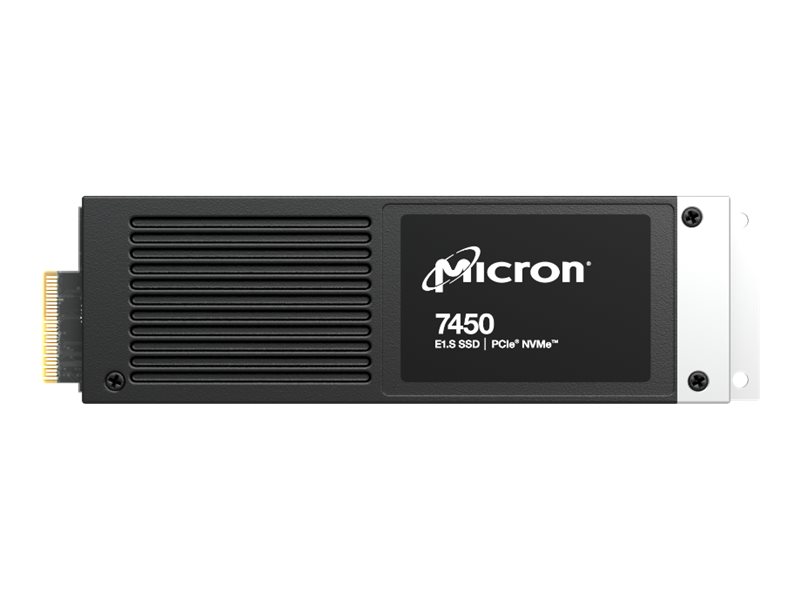
Official Specifications (7.68 TB, per Micron datasheet)
| Attribute | Specification |
|---|---|
| Interface | PCIe Gen4 x4 NVMe |
| Form factors | U.3 15mm, E1.S 5.9mm, E3.S (1T/2T) |
| Capacity | 960 GB – 7.68 TB |
| Sequential read / write | 6,800 / 5,300 MB/s (7.68 TB) |
| Random read / write | 1,000K / 250K IOPS (7.68 TB) |
| Endurance | 1 DWPD (5 years) |
| Reliability | MTBF 2,000,000 hours |
| Security | TCG Opal 2.0, TCG Enterprise, secure erase (SED variants) |
Performance figures are maximum sustained values per the Micron 7450 Pro datasheet; real-world results vary by workload and platform.
Why E1.S/E3.S Beats U.2 in 2026 Servers
The EDSFF family exists because NVMe density outgrew the 2.5-inch U.2 envelope. E1.S (5.9mm) is a short EDSFF card; E3.S (7.5mm) is the full-length version. In a 2U Xeon 6 server, the drive cage holds 8-40 x E3.S drives – versus 8-16 U.2 at best. EDSFF also improves airflow per drive (the wider card channels air across the NAND) and supports the shorter, lower-latency signal paths the Gen5 era needs.
- Density: up to 40 x E3.S in a 2U – a 245 TB+ all-NVMe tier per node at 7.68 TB per drive.
- Cooling: E1.S/E3.S spread heat across the card face, keeping 7.68 TB drives inside airflow spec in 1U and 2U front-bay layouts.
- Forward compatibility: the same E3.S slot accepts Gen4 drives today and Gen5 drives tomorrow (PCIe 5.0 backplane, 4.0 device).
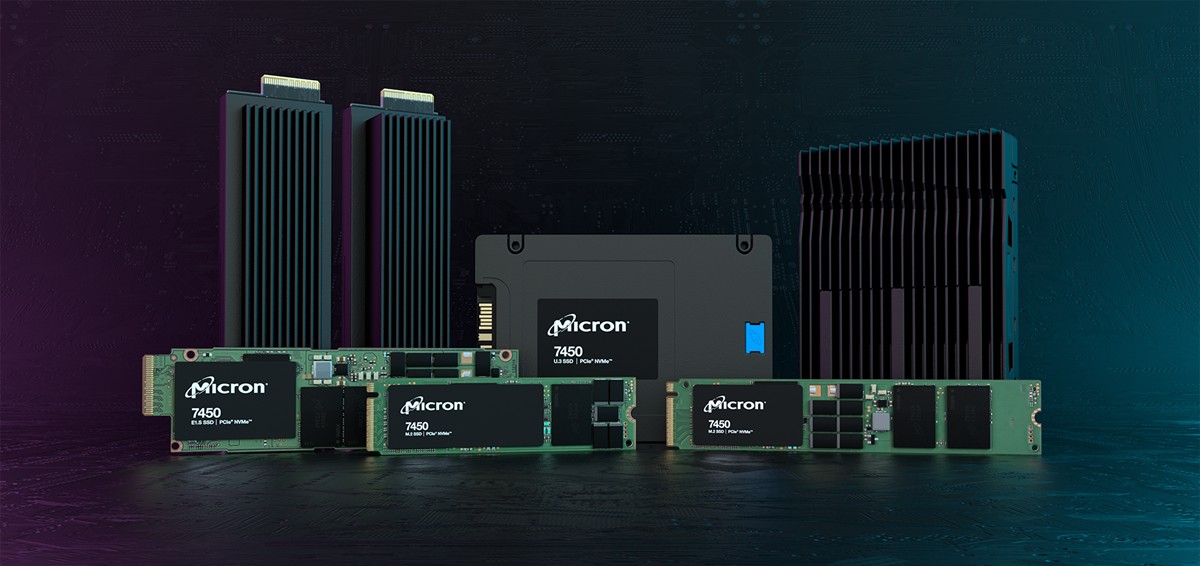

Pro vs Max: Matching Endurance to Workload
| Attribute | 7450 Pro | 7450 Max |
|---|---|---|
| Endurance | 1 DWPD | 3 DWPD |
| Max capacity | 7.68 TB | 6.4 TB |
| Best fit | Read-mostly: VDI, web, AI inference caches, boot tiers | Write-heavy: logging, analytics ingest, caching layers |
The 1 DWPD Pro rating covers the vast majority of production read-mostly tiers. If your workload writes more than one full drive per day, step to the 7450 Max 3 DWPD class instead – the endurance-per-dollar curve flips there.
NAND, Latency and Power: The Specs Under the Specs
The 7450 Pro is built on Micron’s 176-layer TLC NAND with an in-house controller and DRAM for mapping – a 4KB-aligned design that keeps read latency in the low hundreds of microseconds and write latency sub-millisecond under queue depth. For the 7.68 TB capacity point, operating power sits in the ~12 W class during active I/O (idle drops well below 5 W), which matters twice: it keeps E1.S cards inside the thermal budget of 1U airflows, and it lowers the per-TB power cost of an all-NVMe tier versus multiple smaller drives.
| Deep spec | 7450 Pro 7.68 TB |
|---|---|
| NAND | Micron 176-layer TLC, DRAM-backed mapping |
| Latency class | Low hundreds of us read; sub-ms write (QD4+) |
| Operating power | ~12 W class active I/O; <5 W idle |
| Endurance / MTBF | 1 DWPD 5 years / 2,000,000 hours |
| Warranty support | 3-year, competitive channel |
Migration Path: SATA SSD / U.2 to E1.S NVMe
Moving a boot or VDI tier from SATA SSD to E1.S NVMe is a software-free hardware swap in modern tri-mode slots, but plan the migration like a small project:
- Controller check. Confirm the RAID/HBA presents NVMe (PERC H965i-class tri-mode handles NVMe/SAS/SATA in one slot; legacy SATA-only controllers do not).
- Reimage, do not clone raw. For VDI golden images, rebuild from template – the block size and queue-depth behavior change with NVMe.
- Verify slot form. E1.S 5.9mm fits E1.S cages; E3.S 7.5mm fits E3.S cages (R770-class 8-40 bay backplanes); U.2/U.3 drives use 2.5-inch bays. The three are not cross-compatible without an adapter.
- Stagger the cutover. Migrate one node, run the same workload profile for 48 hours, then scale to the fleet.
The 5-Year TCO View: NVMe vs SATA Per Bay
| Cost driver (per 7.68 TB) | SATA SSD | 7450 Pro E1.S NVMe |
|---|---|---|
| Sequential read | ~550 MB/s class | 6,800 MB/s |
| Random read | ~100K IOPS class | 1,000K IOPS |
| Bays needed for same IOPS | ~8-10x more | 1 |
| Power per equivalent IOPS | Much higher | ~12 W per drive |
The NVMe decision is rarely about MB/s on paper – it is about bays and IOPS. When a VDI cluster needs 1M random-read IOPS, one E1.S drive replaces a rack section of SATA SSDs. At that point the price-per-GB comparison stops mattering and the price-per-IOPS comparison takes over, where Gen4 NVMe wins by an order of magnitude.
Workload Fit Quick Guide
- VDI / virtual desktop: 1 DWPD read-mostly profile; boot storms are the classic fit for 1,000K random read.
- AI inference caching: KV-cache and model-shard staging benefit from sub-ms latency at 7.68 TB density.
- Databases (read-heavy): OLTP read caches and analytics staging on NVMe tiers.
- Object storage front tier: E1.S density lets one node hold 40 drives – a 245 TB+ hot tier per 2U.
Deployment Notes
- Server fit: E1.S 5.9mm slots in 1U density builds; E3.S 7.5mm in 2U Xeon 6 cages (R770, R670 class). U.3 15mm remains the standard for 2.5-inch universal bays – see our 7450 Pro U.3 listing for that form factor.
- RAID: tri-mode controllers (e.g. PERC H965i) present E1.S/E3.S NVMe natively; no adapter needed.
- Security: order the SED variant when at-rest encryption is a compliance requirement (TCG Enterprise).
- Pairing: combine with a 24TB CMR HDD tier (e.g. Seagate Exos X24) for a two-tier NVMe-plus-capacity architecture.
Spec-Sheet Traps When Buying E1.S / E3.S SSDs
EDSFF procurement trips buyers more than any other SSD category, because the mistakes are silent – the drive physically fits, and the performance never arrives. Five traps to check before purchase:
- Form-factor trap. E1.S (5.9mm short card) and E3.S (7.5mm full-length card) are different cages. E1.S drives do not seat in E3.S bays and vice versa, and neither fits a 2.5-inch U.2/U.3 bay without an adapter tray. Confirm the server’s backplane part number, not the brochure.
- Generation trap. A Gen4 drive in a Gen5 backplane runs at full Gen4 speed – fine. A Gen5 drive in a Gen4 backplane drops to Gen4 – usually fine too, but the wasted spend is real. Buy media generation to match the platform’s intended lifecycle, not its peak marketing number.
- Security-variant trap. SED (self-encrypting) variants carry different model suffixes and cost a little more. If your compliance baseline requires TCG Enterprise or at-rest encryption, order SED explicitly – a standard drive cannot be upgraded to SED in the field.
- Endurance-unit trap. “1 DWPD” means one full drive write per day for five years. Convert your actual write rate: a 7.68 TB drive at 1 DWPD absorbs ~7.68 TB of writes daily. Log-heavy workloads that write 3x that need the 3 DWPD class (7450 Max) instead.
- Controller trap. Tri-mode controllers (PERC H965i-class) present NVMe natively; legacy SAS-only HBAs see nothing. Verify the controller generation before the drives arrive.
Run these five checks against the quote and the E1.S/E3.S tier behaves exactly like the datasheet promises – no surprise cages, no half-speed media, no failed security audit.
Buying FAQ
- E1.S or E3.S? E1.S for 1U/edge density and short slots; E3.S for 2U Gen5 cages with 8-40 drive options.
- Is PCIe 4.0 obsolete on Gen5 servers? No – Gen5 backplanes run 4.0 devices at full 4.0 speed; the drives are cheaper per TB than Gen5 media today.
- Endurance for VDI? 1 DWPD is the standard VDI tier; random-write patterns stay well inside budget.
- Warranty? competitive supply, 3-year warranty, global shipping.
- E1.S 5.9mm or 15mm? The 7450 Pro E1.S is the 5.9mm short card; 15mm E1.S exists in other families for extra NAND. Check your cage depth before ordering.
- Can I mix 7450 Pro with other NVMe drives? Yes – any tri-mode controller mixes drives by presenting them independently; just keep RAID groups homogeneous for predictable rebuild behavior.
- Is 7.68 TB the largest size? In the Pro line, yes. Beyond that, move to E3.S capacity-class media or a 24TB HDD tier for bulk data.
- What about boot drives? E1.S is overkill for boot; keep a dedicated M.2 boot tier (e.g. BOSS-N1) separate and spend E1.S bays on data.
Building an E1.S/E3.S NVMe tier? As an independent supplier of Dell, xFusion and Micron we supply the 7450 Pro with competitive pricing, 3-year warranty, global shipping and free configuration free configuration consultation, including form-factor and backplane validation for your server model – browse our full range or contact us for a custom-quoted build.