 Xinchuan Server | Enterprise Server Hardware Supplier
When to Move: R760 Racks in the Xeon 6 Era
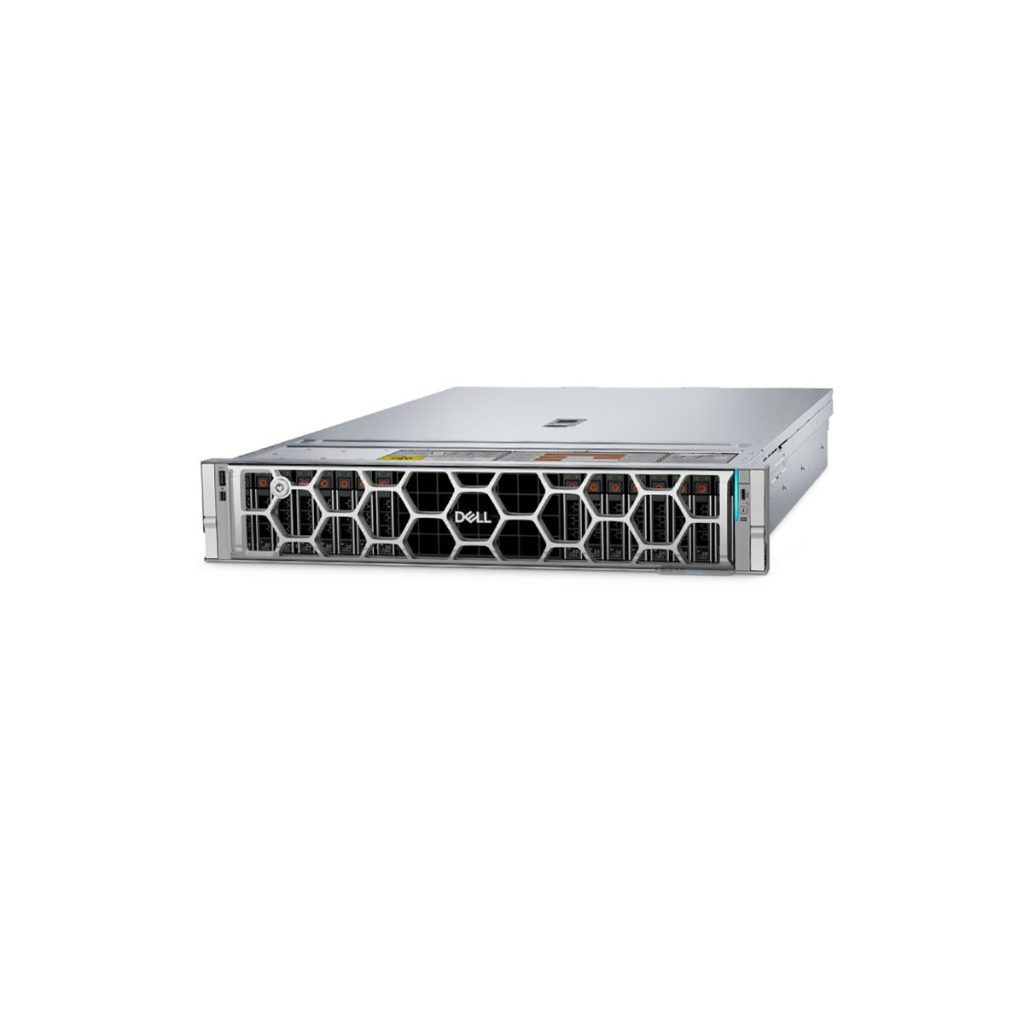
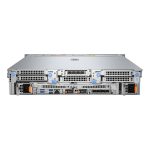
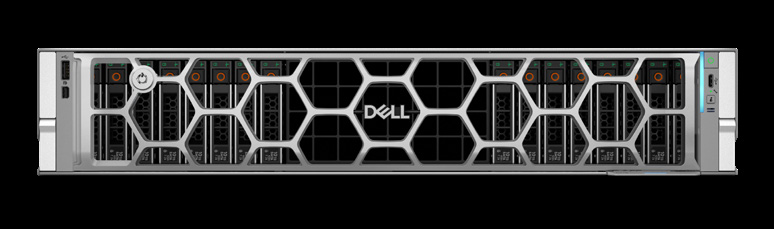
Your R760 generation racks are still under warranty and still running databases fine. So why would a refresh to the PowerEdge R770 make sense in 2026? Because the R770 is not an R760 with faster CPUs – it is a different chassis philosophy. Built on OCP DC-MHS, it makes front-I/O an order-time choice, moves storage to EDSFF E3.S Gen5, and carries 2 x Xeon 6 with up to 144 E-cores or 86 P-cores per socket. If your next 2U refresh is for AI inference, cloud-native density, or a large database that keeps growing, this is the migration path to evaluate.
PowerEdge R770 Specifications
| Component | Specification |
|---|---|
| Form factor | 2U rack – front I/O (cold aisle) or rear I/O (hot aisle) |
| Processor | 2 x Intel Xeon 6 – up to 144 E-cores or 86 P-cores per socket |
| Memory | 32 x DDR5 RDIMM, up to 8 TB, 6400 MT/s, registered ECC |
| Storage | 8-40 x EDSFF E3.S Gen5 NVMe (up to 2457.6 TB); 8/16 x 2.5-inch SATA/NVMe; rear 4 x E3.S |
| Boot | BOSS-N1 DC-MHS – HW RAID 1, 2 x M.2 NVMe |
| RAID | Front PERC H965i / H975i / H365i (tri-mode) |
| Network | 2 x OCP NIC 3.0 (front or rear), 1GbE-400GbE |
| GPU | Up to 2 x 450 W double-wide or 6 x 75 W FHHL |
| DPU | NVIDIA BlueField-3: B3220 2x200GbE or B3140H 1x400GbE |
| Management | iDRAC (10th gen), Redfish, RACADM, Quick Sync 2, NativeEdge |
| Dimensions / weight | 86.8 x 482 mm; 802.40-814.52 mm depth; 28.53 kg |
R760 to R770: What Actually Changes
| Attribute | R760 (Gen 4/5 Xeon) | R770 (Xeon 6) |
|---|---|---|
| CPU generation | Xeon Scalable 4th/5th (up to 64 cores) | Xeon 6 (up to 144E / 86P per socket) |
| Memory speed | DDR5 5600 MT/s | DDR5 6400 MT/s |
| Storage media | 12x 3.5\”/24x 2.5\”/16x E3.S | 8-40x E3.S Gen5 NVMe + rear E3.S |
| I/O placement | Rear I/O only | Front or rear I/O (order-time) |
| Chassis design | Traditional bolted modules | OCP DC-MHS, tool-less hot-swap |
| GPU ceiling | 2x DW / 6x SW | 2x 450W DW / 6x FHHL |
The two jump out: memory bandwidth (6400 MT/s at 32 DIMMs) and the E3.S Gen5 storage tier. Workloads that are memory-bandwidth- or NVMe-lane-bound see the biggest win; pure 3.5-inch bulk storage can stay on an R760-class platform.
Architecture Deep Dive
Networking
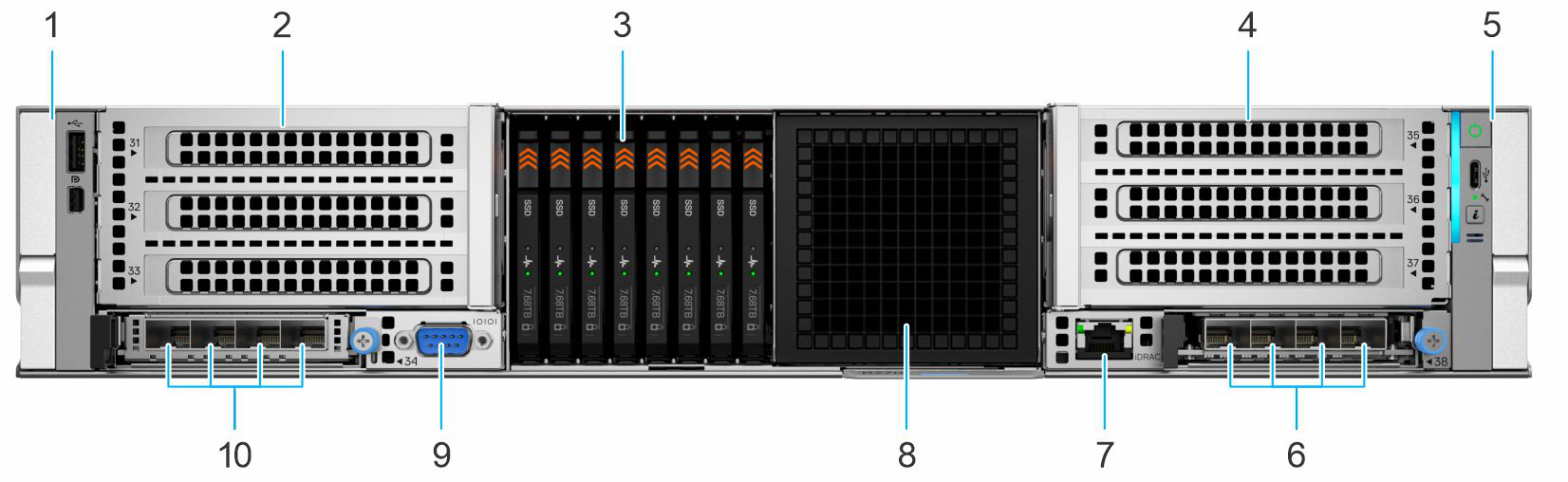
The R770 ships with 2 x OCP NIC 3.0 slots available on either the front or rear of the chassis, covering 1GbE through 400GbE. For smart-NIC deployments, NVIDIA BlueField-3 options (B3220 2x200GbE or B3140H 1x400GbE) bring in-network acceleration and DPU offload without occupying a riser slot – relevant for NVMe-oF, storage disaggregation and zero-trust workloads.
Front Panel & Serviceability
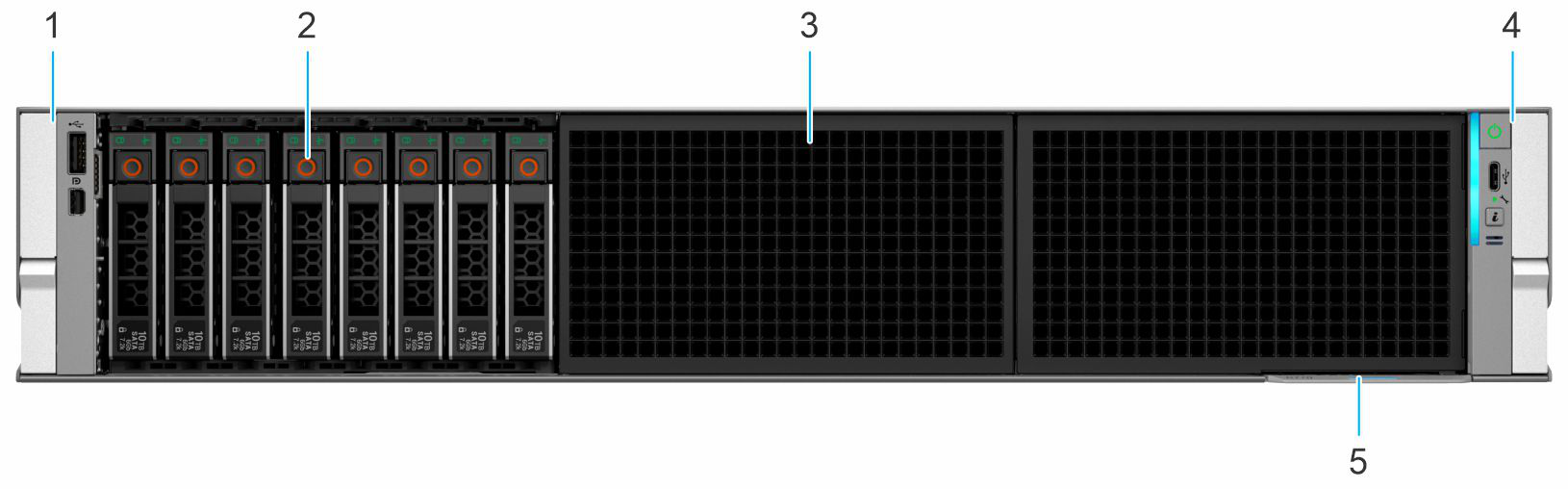
On the front-I/O model, USB, VGA, DB9 serial console and iDRAC Quick Sync 2 sit on the cold aisle – drive swaps and diagnostics no longer require entering the hot aisle. Power supplies, fan modules and the BOSS-N1 boot module are tool-less, hot-swappable units per the DC-MHS design.
Riser & PCIe Gen5
PCIe Gen5 riser architecture supports 2 x 450W double-width accelerators or 6 x FHHL cards. Slot allocation follows the chosen I/O configuration, so state the GPU and NIC plan in the quote – the same chassis serves an inference node or a dense virtualisation host.
RAID & Boot
Front PERC H965i / H975i / H365i controllers provide tri-mode (NVMe/SAS/SATA) support with hardware RAID. Boot comes from BOSS-N1 DC-MHS: hardware RAID 1 across 2 x M.2 NVMe, keeping boot off the data-bay budget.
Security
Platform security follows the PowerEdge baseline: TPM 2.0, UEFI Secure Boot, silicon root of trust, and signed/cryptographically verified firmware, with iDRAC10 hardening for out-of-band management paths.
Management
iDRAC10 (10th generation) provides remote console, virtual media, telemetry streaming, and Redfish/RACADM APIs – plus Quick Sync 2 for phone-based local config and NativeEdge for fleet orchestration. All management features work identically on front- and rear-I/O builds.
Power & Cooling
Redundant hot-swap PSU options up to 2400W with Platinum/Titanium efficiency, matched to the DC-MHS fan array. The 28.53 kg chassis with 802-815 mm depth fits standard 1000-1100 mm racks; verify rail depth for 600mm cabinets before ordering front-I/O versions.
Operating System Support
Certified across the mainstream enterprise stack: VMware ESXi 8, Windows Server 2022/2025, RHEL 9, SLES 15, and Ubuntu 22.04/24.04 LTS.
The Migration Path: 4 Steps
- Profile the workload. Measure core utilisation, memory bandwidth and NVMe IOPS on the R760 estate; label each rack \”density-bound\” or \”capacity-bound\”.
- Pick the I/O side. Hot-aisle-maintained DCs keep rear I/O; high-density cold-aisle layouts should order front-I/O R770s – this one decision changes your cable tray plan.
- Plan the E3.S tier. Migrate hot NVMe data to E3.S Gen5 (up to 40 per 2U); keep 3.5-inch bulk on the storage platform. Budget the boot BOSS-N1 per node.
- Sequence by cluster. Refresh inference/DB nodes first for the 6400 MT/s and PCIe Gen5 win, then scale-out nodes; see our R770 design review for the chassis analysis behind each step.
Buying FAQ
- R770 or R760 for our refresh? Memory-bandwidth, NVMe-density and AI-inference loads justify R770; mixed 3.5-inch storage workloads can stay on the R760.
- Can the R770 host GPUs for inference? Up to 2x 450W double-width (e.g. L40S class) or 6x FHHL – enough for a per-node inference tier.
- Is E3.S required? No – 8/16 x 2.5-inch SATA/NVMe options exist, but the 40x E3.S Gen5 cage is the density play.
- Warranty and support? competitive units with 3-year warranty, global shipping, and configuration support.
Planning an R760-to-R770 migration? As an authorized Dell partner we supply the R770 with competitive pricing, 3-year warranty, global shipping and free configuration consultation – browse our full server range or contact us for a custom-quoted build.