 Синьчуаньский сервер | Поставщик оборудования для корпоративных серверов
The Single-Socket Question Every Cloud Team Asks
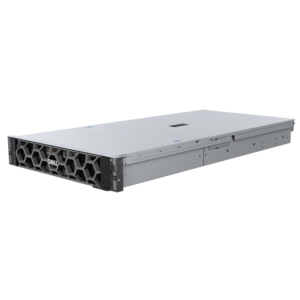
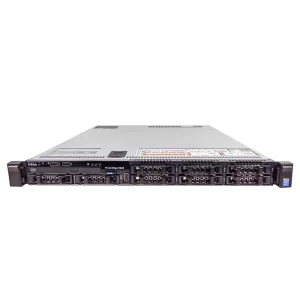
“Why buy a dual-socket server when 80% of my workloads are single-socket-sized?” It is a fair question, and for a growing share of fleets the answer is the Dell PowerEdge R470: one Intel Xeon 6 процессор, 16 Слоты DDR5, 8-16X E3.S Gen5 NVME, and four Gen5 PCIe slots – in the same 1U that a dual-socket box occupies, at a lower acquisition price and a lower power draw. This page runs the ROI math and the full specification so the single-vs-dual decision is a calculation, not a habit.
R470 vs R660xs: The Official Single vs Dual Comparison
| Особенность | PowerEdge R470 | PowerEdge R660xs |
|---|---|---|
| Процессоры | 1х Ксеон 6 (144 Электронные ядра или 86 P-подачи) | Up to 2x Xeon Scalable 4th/5th Gen |
| Memory speed | DDR5 up to 6400 МТ/с | DDR5 up to 5200 МТ/с |
| Слоты DIMM | 16 DDR5 RDIMM (registered ECC) | 16 DDR5 RDIMM |
| Front storage | 8-16X E3.S Gen5 NVME (вплоть до 983.04 ТБ) | 2.5-inch mixed bays |
| PCIe | Up to 4×16 Gen5 slots | Up to 2x Gen5 or 3x Gen4 |
| Ускорители | Up to 4x 75W single-width | No GPU support |
| Масса | 19.11 кг | 19.45 кг |
Источник: Dell PowerEdge R470 Technical Guide (Rev A07, December 2025).
Full Specifications
| Атрибут | Спецификация |
|---|---|
| Фактор формы | 1U стоечный сервер |
| Процессор | 1x Intel Xeon 6: вплоть до 144 Электронные ядра или 86 P-подачи (R1S option: 136 PCIe lanes), 330-350W TDP max |
| Память | 16 DDR5 RDIMM slots (8 каналы), registered ECC, вплоть до 6400 МТ/с |
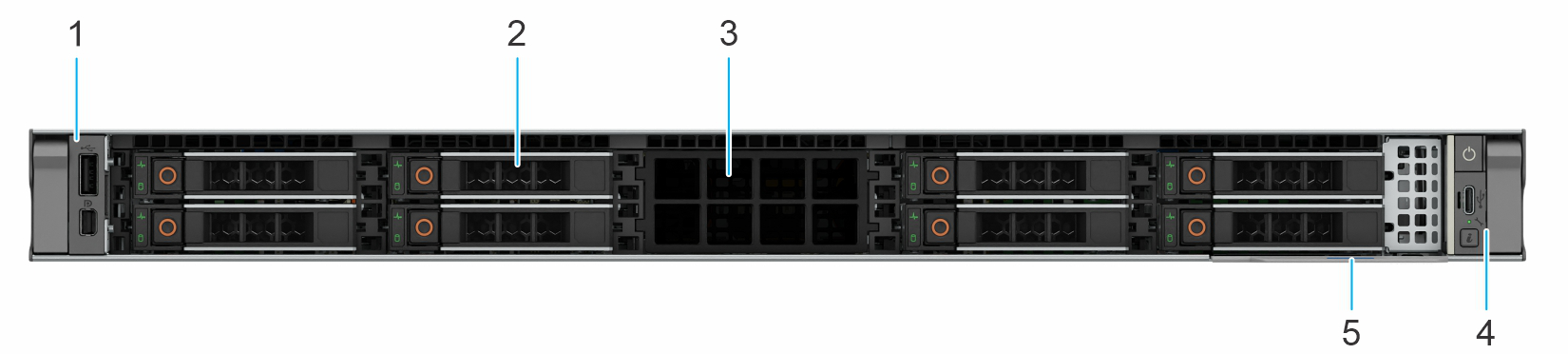
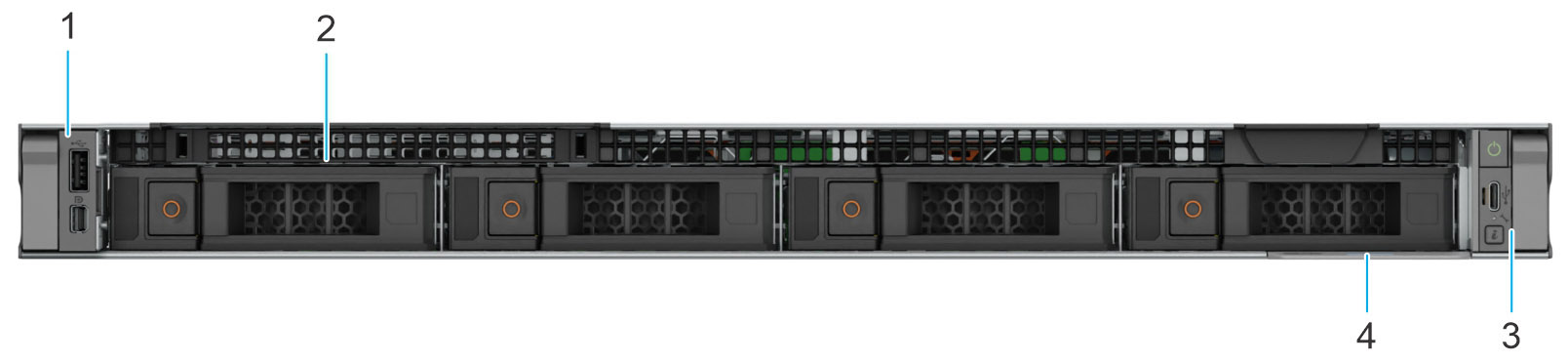
| Storage front | 8x E3.S Gen5 (491.52 ТБ), 16x E3.S Gen5 (983.04 ТБ), 10x 2.5-inch SATA/NVMe (614.4 ТБ), 8x 2.5-inch SATA/NVMe, 4x 3.5-inch SATA (128 ТБ, with 2x E3.S rear) |
| PCIe | Up to 4×16 Gen5 slots; 88 полос на процессор (R1S: 136); bifurcation x16/x8/x4/x2 |
| сеть | OCP сетевой адаптер 3.0: 2 слоты (front I/O) или 1 слот (rear I/O); dedicated BMC Ethernet |
| Boot | БОСС-Н1 DC-MHS: Аппаратный RAID 1, 2x M.2 NVMe |
| Власть | 600W Платина, 700W Титан, 800/1100W Платина/Титан, 1400/1500W Титан, 1800W Титан, -48VDC and 240VDC/277VAC options – two redundant hot-swap PSUs |
| Размеры / weight | 42.8 Икс 482 Икс 815.14-829.44 мм; 19.11 кг (42.13 фунт) |
Parameter Deep-Dive
сеть
OCP сетевой адаптер 3.0 mezzanines in two slots on the front-I/O build (one on rear-I/O), plus a dedicated BMC management port. Card options span 1GbE BASE-T through 100/400GbE – a single 400GbE card leaves three Gen5 slots for storage and accelerators.
Front Panel and I/O
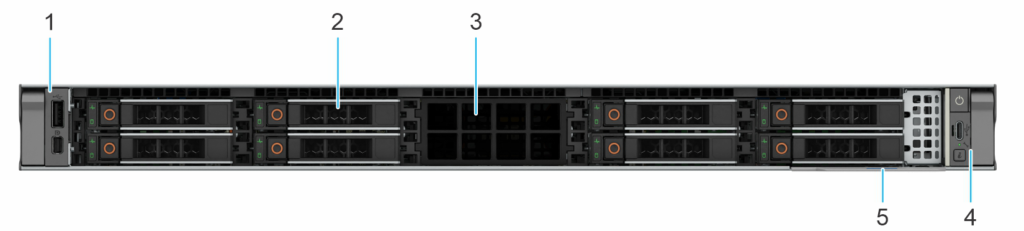
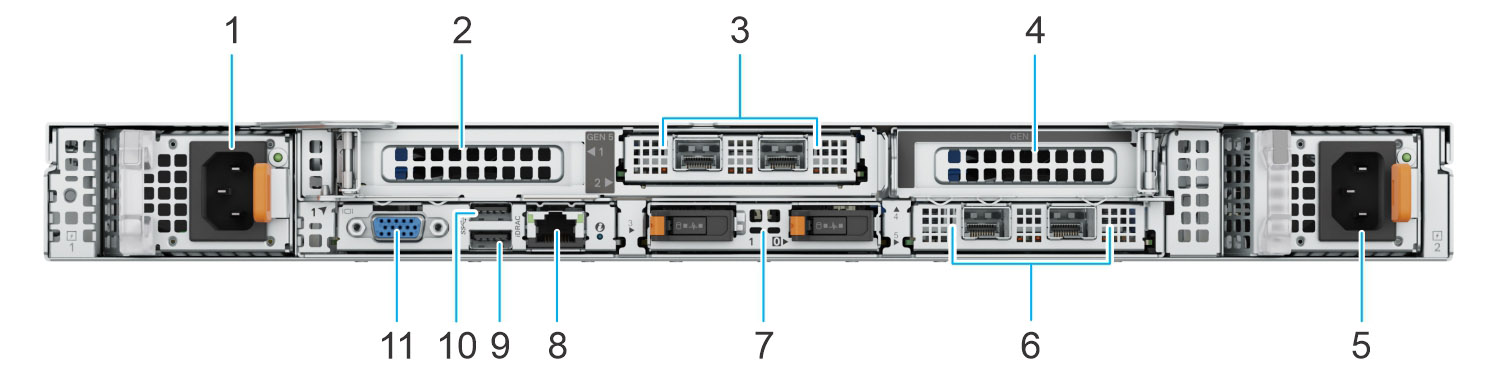
Front-I/O builds bring USB 2.0 Тип-С, optional USB 2.0 Type-A and Mini-DisplayPort, DB9 serial and the BMC port to the cold aisle; rear-I/O builds carry 2x USB 3.1 Тип-А, VGA and the BMC port at the back.
Riser and PCIe Gen5
88 Gen5 lanes per CPU (136 with the R1S P-core option) drive up to 4×16 Gen5 slots with x16/x8/x4/x2 bifurcation – enough for a 400GbE NIC, two dual-port NVMe adapters and an accelerator riser in one 1U. Accelerator support is up to four 75W single-width cards; the R470 is a density/compute box, not a GPU server.
RAID and Boot
Boot rides the БОСС-Н1 DC-MHS – аппаратный RAID 1 across 2x M.2 NVMe – keeping the E3.S bays purely for data. External storage attaches through tri-mode controllers in the Gen5 slots.
Безопасность
Platform security stack: UEFI Secure Boot, доверенный платформенный модуль 2.0, silicon root of trust, and signed firmware verification on every update; the DC-MHS DC-SCM architecture isolates the management plane.
Управление
iDRAC with Lifecycle Controller, iDRAC Прямой, RESTful API iDRAC с Redfish, RACADM CLI and the iDRAC Service Module (Исм) cover out-of-band control, virtual media, telemetry and automation – SNMP and OpenManage Enterprise supported.
Операционные системы
Certified across VMware ESXi 8, Сервер Microsoft Windows 2022/2025, Ред Хэт Энтерпрайз Линукс 9, SUSE Linux корпоративный сервер 15, и Убунту 22.04/24.04 LTS.
The ROI Math: Single vs Dual Socket at Fleet Scale
| Элемент (8-node microservices fleet) | R470 single-socket | Dual-socket 1U |
|---|---|---|
| CPU sockets licensed (VMware-style per-socket) | 8 | 16 |
| Typical node power (steady state) | ~280 W | ~420 W |
| 5-year electricity, 8 узлы | ~$14,700 | ~$22,000 |
| Acquisition (typical configured list) | Lower per node | Higher per node |
Illustrative math at $0.15/kWh with stated load assumptions; re-run with your rates and license model. The savings compound where workloads are horizontally scaled and single-thread-modest – exactly the profile of cloud-native microservices, web front ends, CI runners and edge nodes. The R470 also carries R670/R770-class DR5 6400 MT/s and E3.S Gen5, so the single-socket tier stays on the same memory and storage generation as the dual-socket tier.
Workload Profile: Four Places the R470 Wins
- Cloud-native microservices. The 144 E-core SKU packs the highest core count per 1U at single-socket cost – the ideal ratio for horizontally scaled containers where individual threads are modest and fleet density decides the bill.
- Web and API tiers. Stateless front ends that scale by node count benefit directly from the lower per-node acquisition and power; a 20-node fleet of R470s costs less than a 12-node dual-socket fleet delivering comparable aggregate throughput.
- CI/CD and test fleets. Build runners and ephemeral test clusters that tolerate node-level failure are the classic single-socket home – the redundancy budget is the cluster, not the node.
- Edge and branch aggregation. 42.8mm 1U, 19.11 кг, 600-1100W PSU options and -48VDC support make the R470 a practical edge node for colocation and telco sites where power and space are metered.
Configuration Advice Before You Quote
- Память: 16 DIMMs across 8 каналы – populate 1 DIMM per channel first for full 6400 МТ/с; the 2DPC path doubles capacity at the platform’s 2DPC speed. For microservices, 256-512 GB at 1DPC is the common sweet spot.
- E3.S media: start with Gen4 E3.S drives at Gen4 speed; the Gen5 bays accept them and leave headroom for later flash generations.
- R1S option: if the build carries dense NVMe plus a 400GbE NIC plus accelerators, the P-core R1S processor’s 136-lane budget removes any lane pressure – worth the price delta on I/O-heavy configs.
- блок питания: 800W Platinum covers most single-socket builds at the 50-60% efficiency point; step to 1100W Titanium for 16x E3.S plus a 400GbE card, or -48VDC for telco racks.
- Boot: the BOSS-N1 DC-MHS 960GB pair keeps boot separate from the E3.S data bays – order it as standard, not as an afterthought.
The 5-Year Total Cost Picture
The R470’s economic case is three rows: licensing, власть, and density. Per-socket virtualization licensing halves on single-socket nodes. Steady-state power around 280W against ~420W for a comparable dual-socket node saves roughly 35% of the electricity line. And because the E3.S cage and 6400 MT/s memory match the dual-socket generation, the fleet does not split into two technology tiers. For fleets that are 80% horizontally scaled, the R470 is not the budget option – it is the correct sizing.
Run the same sizing discipline at fleet level: count sockets, count steady-state watts, and count technology generations. Where the workload is horizontally scaled, the single-socket R470 converts those three numbers into a materially lower total cost of ownership — without forking the fleet onto an older memory or storage generation.
Where the Single Socket Fits (and Where It Does Not)
- Fits: container fleets, web/API tiers, CI/CD runners, edge and branch aggregation, light virtualization (8-16 ВМ на узел), scale-out storage front ends.
- Does not fit: GPU-accelerated AI training, 4-socket-scale databases, workloads that genuinely need a second socket’s memory channels or lane budget.
- R1S option: the P-core R1S processor raises the lane budget to 136 – the config for I/O-heavy single-socket builds.
Часто задаваемые вопросы о покупке
- R470 or R670? R470 when the workload fits one socket and 16 Диммс – the cost-per-node leader; R670 when dual-socket compute and 32 DIMMs earn their premium.
- Can it run VDI? Light VDI yes (up to ~16 VMs on 144 E-cores); heavy graphics VDI needs GPU support, which the R470 does not carry – see the R770 for 450W accelerators.
- E3.S or 2.5-inch? All-flash density favors 16x E3.S (983 ТБ); mixed SAS/SATA environments use the 2.5-inch universal or 3.5-inch SATA configs.
- Front I/O or rear I/O? Front I/O for cold-aisle service; rear I/O for security-tight aisles – note the OCP slot count differs (2 против 1).
- Гарантия и поддержка? Прямые цены с завода, 3-год гарантии, глобальная доставка, free consultation.
- Is the R470 liquid-cooled capable? Нет – single-socket 1U builds stay within air-cooled thermal design; liquid cooling is reserved for the 2U R770-class GPU platforms.
- What is the maximum memory? 16 DDR5 RDIMM slots at up to 6400 МТ/с; capacity depends on DIMM density – plan 1DPC for speed, 2DPC for capacity.
- Can the R470 run in a telco rack? Да – -48VDC PSU options and the 1U 42.8mm form factor make it a standard OCP/telco edge candidate.
Sizing a single-socket tier? As an authorized Dell partner we configure the R470 with factory-direct pricing, 3-год гарантии, global shipping and free consultation – including lane-budget validation, memory topology planning and PSU sizing against your fleet power rate. Contact us for a fleet-level quote.