 Servidor Xinchuan | Fornecedor de hardware de servidor empresarial
Four Sockets in 2U: Why the R860 Exists
The PowerEdge R860 answers a specific question: what do you do when two sockets cannot hold the working set? SAP HANA scale-up, large in-memory analytics and consolidated 4-socket databases need more memory than any 2-socket node can carry – and the R860 delivers up to 16TB of DDR5 in a standard 2U chassis, replacing the older R840 with a Gen5-era platform.
Platform Overview
| Atributo | R860 |
|---|---|
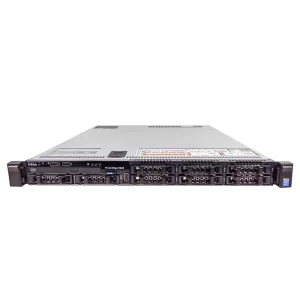
| Fator de forma | 2Rack em U, 869.2 mm depth (no bezel) |
| Processadores | Up to 4x 4th Gen Intel Xeon Scalable, até 60 cores each, 350W TDP, 80 PCIe 5.0 pistas por CPU |
| Memória | 64 DDR5 RDIMM slots, up to 16TB; 4800 Mt/s (1 DPC) / 4400 Mt/s (2 DPC) |
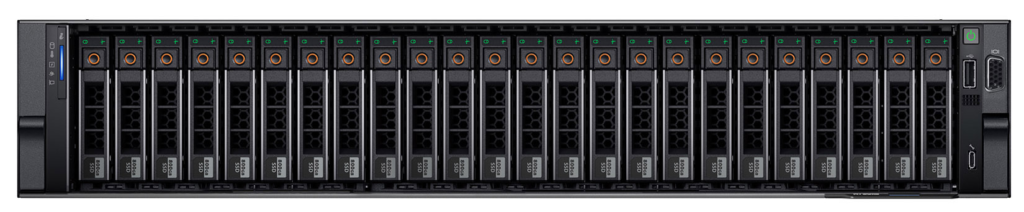
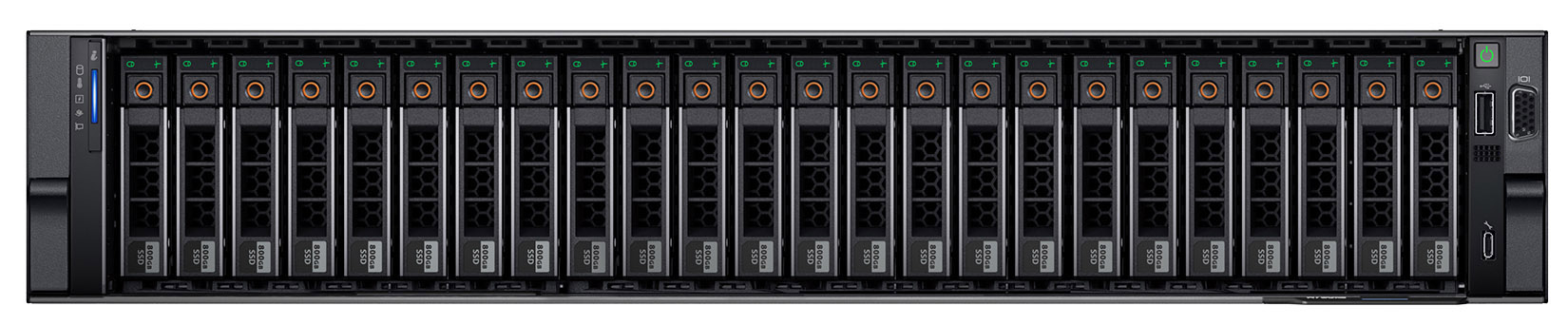
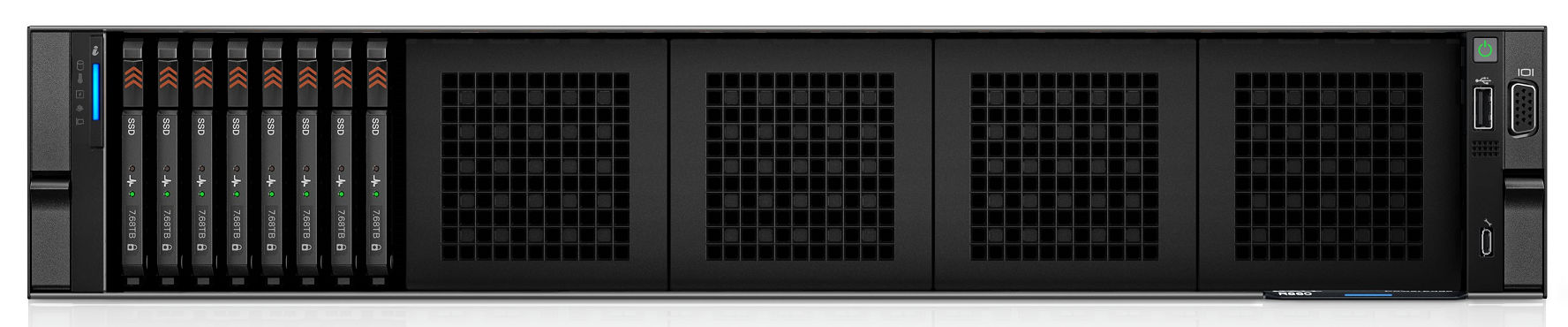
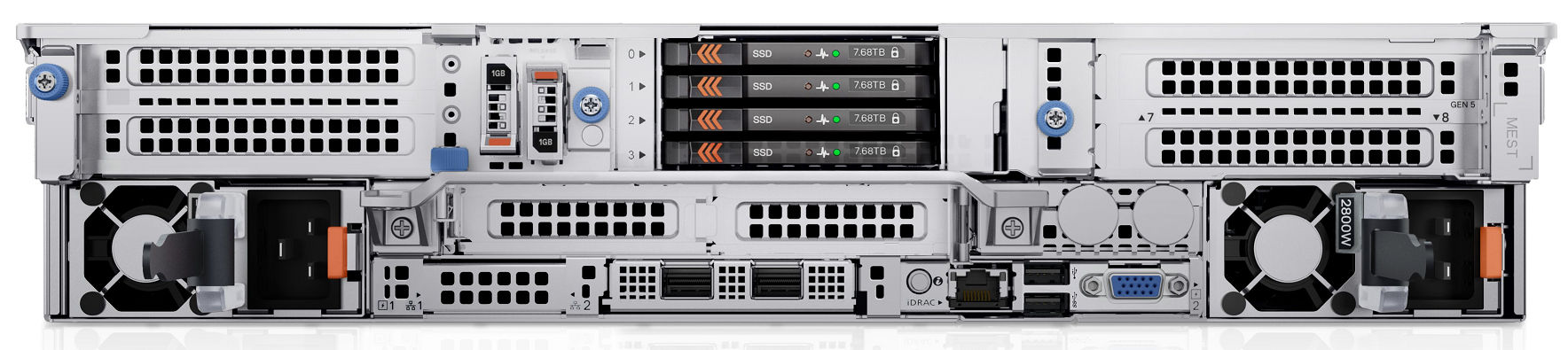
| Armazenar | Up to 24x 2.5-inch SAS/SATA/NVMe or 8x E3.S Gen5 (front) + 2x 2.5-inch or 4x E3.S Gen5 (rear) |
| PCIe | Up to 8x PCIe Gen5 x16 slots; OCP Mezzanine 3.0 |
| ATAQUE | PERC 11/12 (H755, H965i/H965e), HBA465i/e, Boss-N1, software RAID S160 |
| Gerenciamento | IDRAC9, Idrac Direct, API Cantarilho, Sincronização rápida 2 |
| Poder | 2x redundant PSU: Titanium 1100W, Platinum 1400W, Titanium 1800W, Platinum 2400W (AC/HVDC) |
Config Calculator: SAP HANA Memory Sizing
- Working set: sum of hot data + column-store + delta + 20% headroom. A 4TB HANA database with 1:2 compression needs roughly 2.2-2.5TB of server memory.
- DIMM plan: 64 slots. 1 DPC runs 4800 MT/s but caps capacity; 2 DPC reaches 16TB at 4400 Mt/s. For HANA, capacity beats peak speed – run 2 DPC with 256GB RDIMMs (8TB class) or 512GB (16TB class) if the budget allows.
- Verify NUMA: four sockets mean four NUMA domains; pin HANA instances and their memory pools per socket to avoid cross-socket traffic.
- Boot and log: Boss-N1 (2x M.2 NVMe RAID1) for boot, E3.S Gen5 NVMe for HANA data/log/backup volumes.
R840 to R860 Migration
| R840 (previous gen) | R860 |
|---|---|
| 48 DDR4 DIMM + Optane PMem | 64 DDR5 RDIMM, up to 16TB, no PMem dependency |
| PCIe Gen3 slots | Up to 8x PCIe Gen5 x16 slots |
| PERC 9/10 (H740p/H840) | PERC 11/12 (H965i/H965e), HBA465 |
| 24G SAS/6G SATA, Gen3/4 NVMe | 24G SAS, Gen4 NVMe, plus E3.S Gen5 front/rear |
| 865.9 mm depth | 869.2 mm depth – rack depth check required |
The migration path is export-backup-restore: back up HANA at the storage layer, restore onto the R860’s NVMe, then re-point the scale-up licenses. Expect materially faster column scans on Gen5 NVMe and DDR5 bandwidth.
Procurement Traps on 4-Socket Servers
- License math: SAP HANA is licensed per GB of memory – a 16TB R860 costs far more in license than hardware. Size the DB, then size the box, not the reverse.
- Memory topology: verify 1 DPC vs 2 DPC speeds in the quote; vendors quoting 4800 MT/s on a full 16TB build are not reading the spec sheet.
- Baías traseiras: 24x 2.5-inch front config leaves rear room for 2x 2.5-inch or 4x E3.S – confirm the backplane SKU matches your boot/NVMe plan.
- PSU class: 4x 350W CPUs plus 24 drives can exceed 2kW; order 2400W Platinum pair, not 1100W.
- Rack depth: 869.2mm is long for standard 800mm cabinets – verify cable management arms and rail fit.
Workload Fit
- SAP HANA scale-up: the primary design point – see our SAP HANA deployment guide for R960/R860 sizing.
- Large in-memory analytics: 64 DDR5 slots beat any 2-socket node for column-store analytics.
- Consolidated databases: run multiple mission databases with resource isolation on one 4-socket host instead of several 2-socket boxes.
- VDI and desktop virtualization: high-core-count 4S nodes sustain dense RDSH pools.
Detailed Specs, Dimension by Dimension
Rede
- LOM board: 2x 1GbE with Broadcom BCM5720 (opcional)
- OCP Mezzanine 3.0 slot supported by up to 16 PCIe lanes – 25GbE/100GbE mezz options
- PCIe Gen5 slots carry full-height NICs at 32 GT/s when network density demands
Front and Rear I/O
- Frente: 1x USB 2.0, 1x iDRAC direto (Micro-AB USB), 1xVGA
- Traseira: 1x dedicated iDRAC Ethernet, 1x USB 3.0, 1x USB 2.0, 1xVGA (optional on liquid-cooled configs), optional serial via STD RIO board
- interno: 1x USB 3.0; optional LCD bezel or security bezel
Riser and PCIe Architecture
- 80 PCIe 5.0 lanes per CPU at 32 Gt/s; up to 8x Gen5 x16 slots system-wide
- Flexible riser layout across sockets 1-4; plan slot-to-NUMA affinity before ordering
RAID and Boot
- PERC 11: H355, H755; PERC 12: H965i, H965e (modo triplo)
- HBA 11/12: HBA355i/e, HBA465i/e
- BOSS-N1 for OS boot (2x M.2 NVMe, RAID de hardware 1); software RAID S160 for SATA
Segurança
- TPM 2.0, UEFI Secure Boot, silicon root of trust, signed firmware and secure boot chain verified at every POST – Dell PowerEdge platform security baseline
Gerenciamento
- IDRAC9: remote console, virtual media, telemetry streaming, lifecycle log
- iDRAC Direct via Micro-AB USB; Redfish RESTful API; RACADM; Sincronização rápida 2
- OpenManage Enterprise, Ansible and Terraform modules, ServiceNow and System Center integrations
Physical and Environmental
- 2Rack em U; 869.2 mm depth (no bezel); standard 482 mm width, 86.8 mm height
- Operating ambient 10-35 deg C; extended ranges available on qualified configs
Operating Systems
- VMware ESXi, Windows Server with Hyper-V, RHEL, SLES, Ubuntu Server LTS – Dell certified releases per OS Support matrix
Poder
- Two redundant PSUs (1+1): Titanium 1100W, Platinum 1400W, Titanium 1800W, Platinum 2400W AC/HVDC
- 60mm PSU form factor on 15G design; 86mm 2400W class for maximum headroom
4-Socket Platform Matrix
| Plataforma | Fator de forma | Memória | Best for |
|---|---|---|---|
| R860 | 2você, 869milímetros | 64 Dr5, 16tb | Density-constrained 4S scale-up |
| R960 | 4você | 64 Dr5, 16tb, 12x PCIe Gen5 | Maximum expansion and GPU-assisted |
| R7715 | 2U single EPYC 9005 | 24 Dr5, 6tb | Per-socket licensing cost focus |
| R770 | 2U dual Xeon 6 | 32 Dr5, 8tb | Workloads that fit two sockets |
Deployment Snapshot: In-Memory Analytics Consolidation
A regional bank consolidated six 2-socket analytics nodes into two R860s. The win was memory: 4.5TB of usable HANA working set across 128 DDR5 slots with room to grow, versus 2.4TB across the old fleet. Cross-socket NUMA pinning held column scans within socket-local memory, and the 8x E3.S Gen5 NVMe layout carried the data/log tier at Gen5 bandwidth. PDU power dropped from 8.2kW to 5.1kW after decommissioning the legacy nodes.
Ordering Checklist: What to Verify Before Signing
- Memory plan on paper: request the exact DIMM map (classificação, DPC, speed per slot) – a 16TB quote at 4800 MT/s is a red flag unless it is 1 DPC.
- Backplane SKU: confirm front bay type (24x 2.5-inch vs 8x E3.S) and rear bay option (2x 2.5-inch or 4x E3.S) match the storage design.
- PERC class: H965i (internal) vs H965e (external) – expansion enclosures need the ‘e’ variant with external ports.
- PSU and power cords: 2400W Platinum pair for 4x 350W CPU builds; verify C19-style cord/PDU compatibility at 200-240V.
- iDRAC licensing tier: confirm iDRAC9 Enterprise entitlement in the quote for telemetry and virtual media.
- Rack depth survey: measure rail-to-rail depth with cable arms; 869.2mm chassis needs a 1000mm+ cabinet or a rear offset kit.
Lifecycle and Support
The R860 is a 4th Gen Xeon Scalable platform with a long support tail: Dell keeps firmware, driver and OS certification matrices current through the platform’s standard lifecycle, and iDRAC9 telemetry feeds OpenManage Enterprise for proactive alerting. For mission databases, pair the platform with Dell ProSupport Plus or a partner-managed 3-year warranty plan – our standard quote includes 3-year warranty, factory-direct pricing, global shipping and free configuration consultation, with optional on-site NBD for production HANA nodes. Spares strategy: keep one 2400W PSU, one PERC H965i and one E3.S boot drive on the shelf per cluster to cut MTTR to minutes.
Buying FAQ
- Why choose R860 over R960? Both are 4-socket; R860 is 2U (869milímetros) com 64 DDR5 slots, R960 is 4U with more drives and PCIe slots. Choose R860 for density, R960 for maximum expansion.
- Does it support E3.S Gen5 drives? Sim – 8x E3.S front (and 4x rear in the 24x 2.5-inch config).
- What management does it ship with? iDRAC9 with iDRAC Direct, Redfish RESTful API, Sincronização rápida 2, OpenManage Enterprise and Ansible/Terraform modules.
- Can the R860 run 4th Gen Xeon Scalable and newer CPUs? It is designed for 4th Gen Xeon Scalable (até 60 núcleos, 350C); for Xeon 6 workloads look at the R670/R770 generation instead.
- How many drives can it hold? Up to 24x 2.5-inch front (SAS/SATA/NVMe) plus 2x 2.5-inch or 4x E3.S rear, or 8x E3.S Gen5 front – pick the backplane variant that matches the workload.
- Garantia? As an authorized Dell partner we quote factory-direct pricing with 3-year warranty, global shipping and free consultation – including HANA sizing and memory topology validation.
The R860 is the density answer for scale-up memory workloads: four sockets, 64 DDR5 slots and up to 16TB in a standard 2U footprint. Sizing a 4-socket platform? Contact us for a configuration worksheet covering memory topology, NVMe layout and PSU class for your exact database workload, with a per-socket NUMA map and a license-cost comparison against the 2-socket alternative.