 新川サーバー | エンタープライズ サーバー ハードウェア サプライヤー
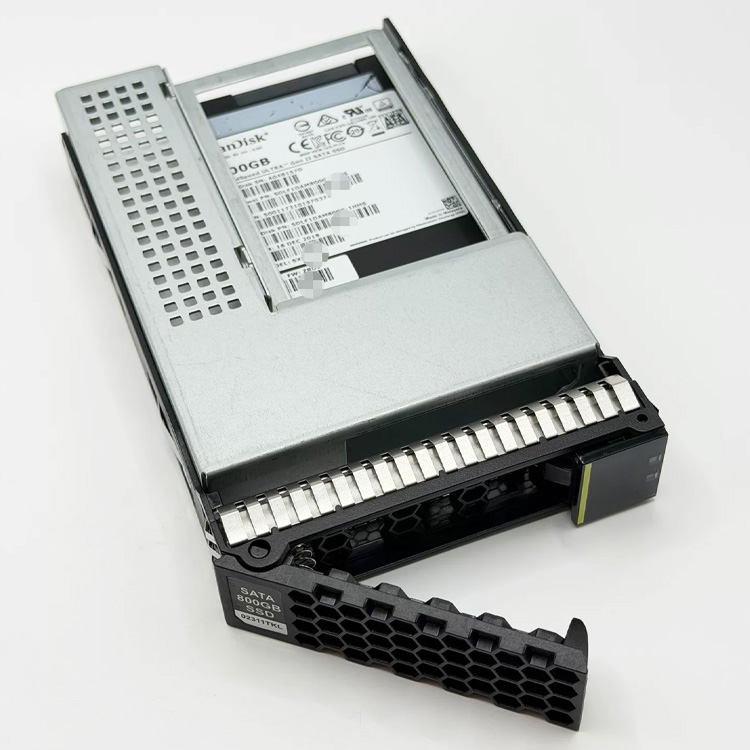
Four Myths About High-Capacity Enterprise Hard Drives — Debunked With Real Numbers
Myth #1: “All 22TB drives use SMR.” The WD Ultrastar DC HC570 uses CMR (Conventional Magnetic Recording) with energy-assisted PMR (ePMR) and OptiNAND technology — not SMR. Sequential and random write performance is consistent, with no write-amplification penalty and no performance collapse when the drive’s internal CMR-to-SMR translation layer fills up. For ZFS, セフ, and any array that does mixed read-write workloads, CMR is non-negotiable. The HC570 delivers it at 22TB.
Myth #2: “Helium-filled drives leak and fail after 3 years.” WD’s HelioSeal technology has been in production since 2013 (HGST Ultrastar He6). Field data from hyperscale customers shows annualized failure rates (AFR) on helium-sealed 22TB drives at 0.35% — lower than the 0.73% AFR on equivalent-capacity air-filled drives. The helium molecules are larger than the atomic gaps in the hermetic seal; leakage rates are measured in decades, not years.
Myth #3: “22TB drives are too slow for anything but cold storage.” At 265 MB/s sustained transfer and 550 TB/year workload rating, the HC570 handles warm-tier storage, backup repositories, media archives, and file servers without becoming a bottleneck. Pair it with NVMe SSDs as a cache tier for performance-critical workloads. The IOPS gap between HDDs and SSDs is real, but the capacity gap is larger — and for 80% of enterprise data, capacity per dollar matters more than IOPS per dollar.
Myth #4: “You cannot mix drive capacities in a RAID array.” You can mix 22TB, 20結核, and 18TB drives in the same RAID array — but all drives will be limited to the smallest capacity in the array. Replacing 18TB drives with 22TB drives one at a time within a RAID group wastes the incremental capacity until the last 18TB drive is replaced. The correct migration path: create a new RAID group with 22TB drives, migrate data, decommission the 18TB group. Or use non-RAID architectures (セフ, ZFS) where mixed drive sizes are handled natively at the pool level.
技術仕様
| パラメータ | 仕様 |
|---|---|
| 容量 | 22結核 (また: 18結核, 20TB in DC HC5xx series) |
| フォームファクタ | 3.5-インチ LFF |
| インタフェース | SAS 12Gb/秒 |
| 回転速度 | 7,200 RPM |
| Recording Technology | CMR (ePMR + OptiNAND), energy-assisted perpendicular magnetic recording |
| キャッシュ | 512 MB buffer + OptiNAND (embedded UFS NAND for metadata acceleration) |
| Sustained Transfer Rate | まで 265 MB/s |
| Average Latency | 4.16 ms |
| MTBF | 2,500,000 時間 |
| AFR (Annualized Failure Rate) | 0.35% |
| Workload Rate Limit | 550 TB/year |
| Unrecoverable Bit Error Rate | 1 sector per 10^15 bits read |
| 力 (アイドル状態 / オペレーティング / Peak Spin-Up) | 5.6W / 7.4W / 25W (spin-up) |
| Sealing | HelioSeal (hermetically sealed, helium-filled, 7th generation) |
| セクタサイズ | 512e or 4Kn (selectable at format) |
| ショック (オペレーティング / Non-Operating) | 50G / 250G (2 ms) |
| Rotational Vibration | RVFF (Rotational Vibration Feed Forward) sensor array |
| Physical | 147.0 バツ 101.6 バツ 26.1 んん, 690g |
| 温度 | 5°C to 60°C |
| 保証 | 5-年限定 (メーカー) |
OptiNAND — What It Actually Does
OptiNAND embeds an iNAND UFS (Universal Flash Storage) chip on the HDD PCB. It stores metadata — write cache state, servo positioning data, and defect maps — that was previously stored on a portion of the spinning platters. By moving metadata to persistent flash, the drive recovers roughly 2-3% of usable capacity that was consumed by metadata overhead on the platters. More importantly, it eliminates the need for a DRAM-based write cache to be flushed to platters on unexpected power loss — the OptiNAND flash retains write cache state across power cycles without consuming drive platter space.
互換性のあるプラットフォーム
Compatible with all Dell PowerEdge servers with 3.5-inch SAS backplanes, xFusion フュージョンサーバー V7, Lenovo Thinksystem, and any SAS 12Gb/s platform. Full compatibility with PERC H730/H740/H750/H755/H965i, LSI/Broadcom 93xx/94xx/96xx SAS HBAs.
新川経由のソース
We supply WD Ultrastar enterprise drives with factory-direct pricing, 3-年保証, そして世界的な発送. Volume discounts for 20+ ドライブ.