 Servidor Xincuan | Proveedor de hardware de servidor empresarial
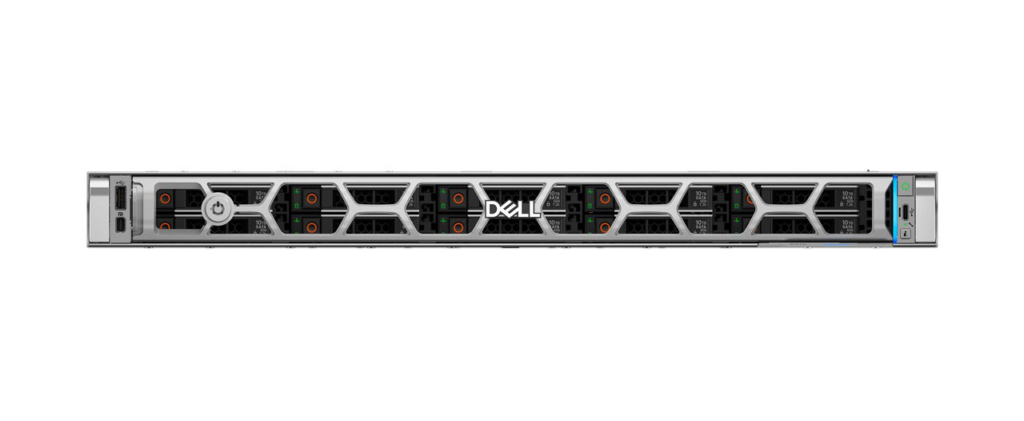
1U 的密度,Xeon 6 的能效:R670 的平衡术
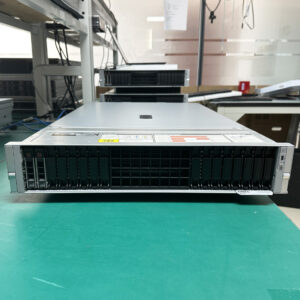
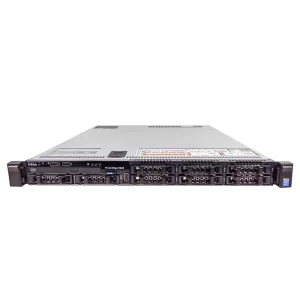
机架密度和功率预算从来是一对矛盾:塞进 1U 的服务器要么牺牲性能,要么牺牲扩展性。Dell PowerEdge R670 用 Intel Xeon 6 的 E-core/P-core 双核架构建成了这个平衡——1U 双路机箱里支持最多 144 个 E-core 或 86 个 P-core 每路,配合 32 条 DDR5-6400 内存和最多 20 块 E3.S Gen5 NVMe,把”密度优先”和”性能优先”两种形态放进同一个平台。相比上一代,R670 提供最高 1.69 倍的每瓦性能,是虚拟化、云原生、全闪 SDS 和高性能计算的密度型选择。
Core Specifications
| Atributo | Especificación |
|---|---|
| Factor de forma | 1servidor en rack U (rear I/O or front I/O cold-aisle) |
| Procesador | 2 x Intel Xeon 6, hasta 144 núcleos electrónicos o 86 P-cores per CPU |
| Memoria | 32 x DDR5 RDIMM slots, hasta 8 tuberculosis, 6400 MT/s |
| Almacenamiento | Hasta 20 x EDSFF E3.S Gen5 NVMe (1228.8 tuberculosis) o 8/10 x 2.5-inch SATA/NVMe |
| Boot | BOSS-N1 DC-MHS: HW RAID 1, 2 x M.2 NVMe |
| REDADA | PERC frontal H965i / H975i / H365i |
| Red | 2 x tarjeta de red OCP 3.0 tragamonedas, 1GbE-400GbE; BlueField-3 DPU options |
| PCIe | Hasta 5 x Gen5 slots (2 x16 front riser + 3 x16/x8) |
| GPU | Hasta 3 X 75 W single-wide |
| Gestión | iDRAC with Redfish, iDRAC directo, RACADM, Sincronización rápida 2, NativeEdge |
| Dimensiones / weight | 42.8 X 482 milímetro; profundidad 816.92 milímetro (rear I/O, con bisel); 20.42 kg |
E3.S Configuration Calculator: Match Density to Workload
The R670’s front bays are built around EDSFF E3.S Gen5 NVMe – the form factor that packs the most flash into 1U. Choose the layout by workload:
| Configuration | Capacidad | Best for |
|---|---|---|
| 8 x E3.S NVMe | Hasta 491.52 tuberculosis | General virtualization, mixed I/O |
| 16 x E3.S Gen5 | Hasta 983.04 tuberculosis | All-flash SDS, database caching |
| 20 x E3.S Gen5 | Hasta 1228.8 tuberculosis | Max-density NVMe, hyperscale |
| 8 x 2.5-inch SATA/NVMe | Hasta 491.52 tuberculosis | Legacy bay compatibility, SATA estates |
| 10 x 2.5-inch SATA | Hasta 38.4 tuberculosis | Cost-focused capacity nodes |
Rear bays add up to 2 x E3.S Gen5 NVMe for OS/log duty, keeping the front fully populated with data drives.
Front I/O vs Rear I/O: The Cold-Aisle Choice
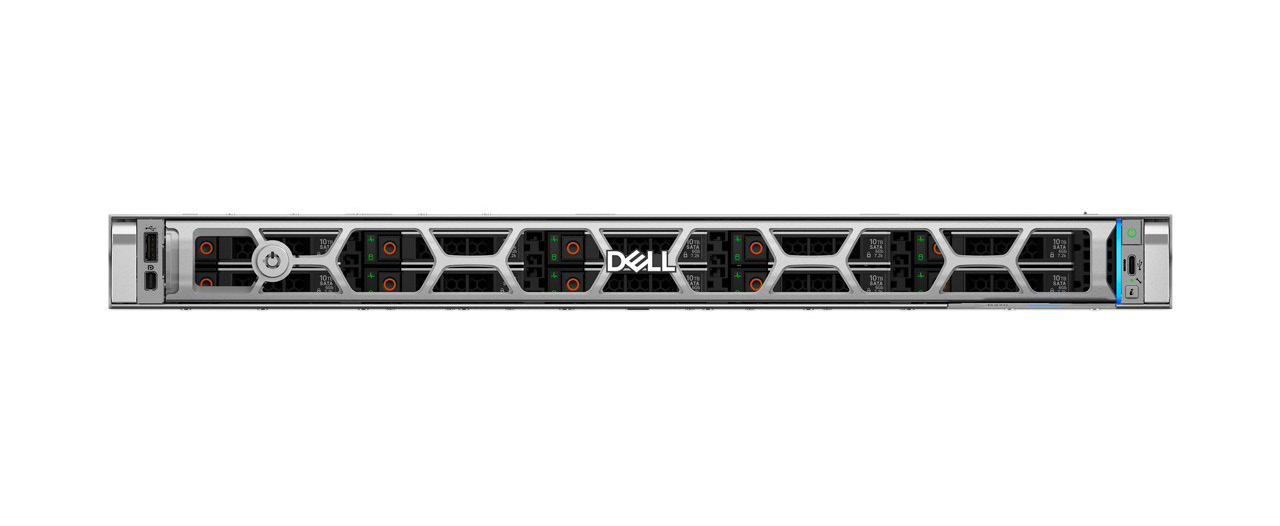
One feature most 1U servers lack: a choice of service orientation. The R670 ships in rear I/O (hot aisle) o front I/O (cold aisle) configurations. Front I/O puts ports, iDRAC and drive bays on the cold aisle, cutting maintenance time and improving uptime in dense deployments – with a DB9 serial port on the front in that configuration. If your racks are standard rear-service, the rear I/O version keeps familiar cabling. Specify the orientation at order time; it changes the chassis depth (829.44 mm front I/O vs 816.92 mm rear I/O).
Network and DPU Options
Two OCP NIC 3.0 tragamonedas (x16 Gen5 each) accept 1GbE through 400GbE cards – enough for dual 100GbE fabric links or a 400GbE spine uplink. For smartNIC architectures, the R670 offers NVIDIA BlueField-3 DPU options (2 x 200GbE B3220 or 1 x 400GbE B3140H), offloading networking, storage and security from the Xeon 6 cores to the DPU. BOSS-N1 lives on a dedicated internal slot (front or rear), so boot storage never consumes a data bay or PCIe slot.
Seguridad & Gestión
Seguridad. Silicon root of trust anchors boot integrity; Arranque seguro, cryptographically signed firmware, Secured Component Verification, Borrado seguro, System Lockdown and chassis intrusion detection protect from factory to decommission. TPM 2.0 ships FIPS/CC-TCG certified.
Gestión. iDRAC provides out-of-band control with Redfish RESTful API, iDRAC directo (USB), RACADM CLI and the iDRAC Service Module; Sincronización rápida 2 enables wireless on-site management. Fleet-level, OpenManage Enterprise integrates with VMware vCenter, System Center, Ansible and Terraform, with NativeEdge Orchestrator for edge deployments (asterisk-marked features per Dell availability).
Fuerza, Enfriamiento & Físico
- fuente de alimentación: Hot-swap redundant: 1500 W / 1100 W / 800 W Titanio, 1100 W / 800 W Platino, 1800 W HLAC Titanium*, 1500 W 277 VAC*, y 1400 W LVDC (-48 a -60 VCC) for telco environments.
- Enfriamiento: Air-cooled with Dell Smart Power and Cooling Technology, or optional Direct Liquid Cooling (rack solution with manifolds/CDU); hasta 4 dual-fan modules (HPR Silver or STD).
- Físico: 42.8 X 482 milímetro, profundidad 816.92-829.44 mm by configuration; weight 20.42 kg.
SO & Hypervisor Support
Servidor canónico Ubuntu LTS, Red Hat Enterprise Linux, Servidor empresarial SUSE Linux, VMWare ESXi, and Microsoft Windows Server with Hyper-V (P-core only). For E-core-optimized Linux workloads, the platform’s scheduling works best on modern kernels – confirm the kernel version with your distro.
Buying FAQ
- E-core or P-core? E-cores maximize thread density (144 por CPU); P-cores maximize single-thread performance (86 por CPU). Pick by workload mix.
- How many NVMe? Hasta 20 x E3.S Gen5 front + 2 x E3.S rear.
- 400GbE ready? Sí – OCP 3.0 slots support up to 400GbE cards.
- DPU support? NVIDIA BlueField-3 2x200GbE or 1x400GbE.
- Remote management? iDRAC with Redfish, iDRAC Direct and RACADM.
Building a dense 1U fleet? See the 2U expansion-focused PowerEdgeR760 for mixed workloads. As an authorized Dell partner we offer factory-direct pricing, configuración personalizada, 3-year warranty and global shipping – contact us for a density/power TCO review.